About Pycnonotus cafer (Linnaeus, 1766)
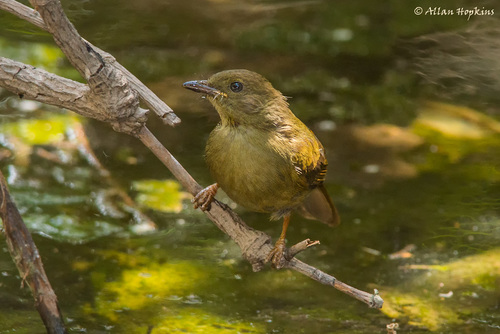
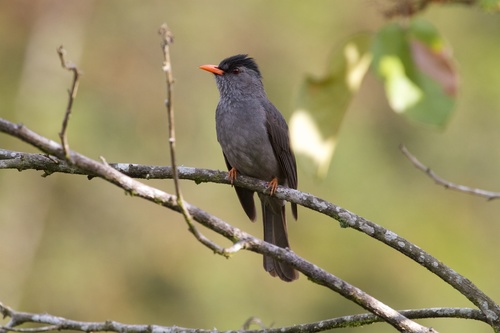
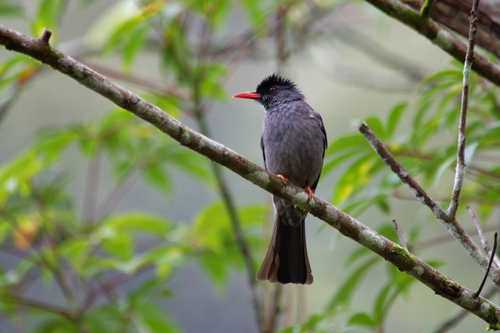
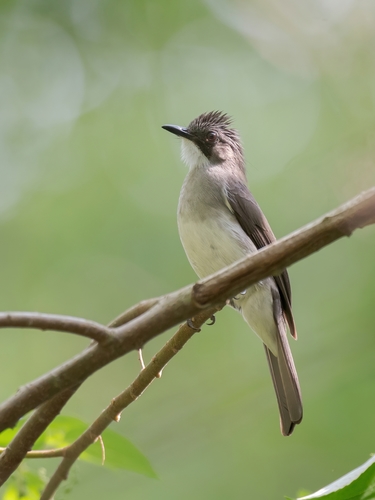
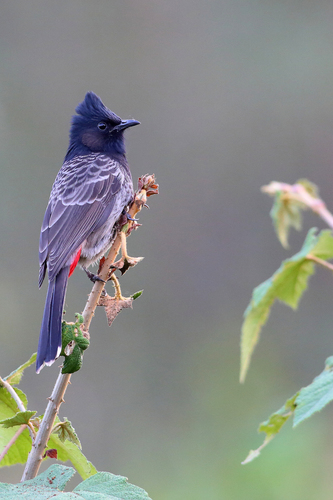
The red-vented bulbul (Pycnonotus cafer) is easily identified by its short crest that gives the head a squarish appearance. Its body is dark brown with a scaly pattern, while the head is darker or black. It has a white rump, red vent, and reaches about 20 cm in total length, with a long black tail tipped in white. Races from the Himalayan region have a more prominent crest and more streaking on the underside. The Western Himalayan race intermedius has a black hood that extends to the mid-breast. The population bengalensis, found in the Central and Eastern Himalayas and the Gangetic plain, has a dark hood, lacks the scale-like pattern on the underside, and instead has dark streaks on the paler lower belly. Race stanfordi from the South Assam hills is similar to intermedius. The desert race humayuni has a paler brown mantle. The nominate race cafer is found in Peninsular India. The Northeast Indian race wetmorei falls between cafer, humayuni, and bengalensis in characteristics. The Sri Lankan race haemorrhous (also written as haemorrhousus) has a dark mantle with narrow pale edges. Race humayuni is known to hybridize with Pycnonotus leucogenys; these hybrids were once described as the subspecies magrathi, marked by pale rumps and yellow-orange or pink vents. There is some natural hybridization with Pycnonotus aurigaster in eastern Myanmar. The sexes have similar plumage, but young birds are duller in colour than adults. The species' typical call has been transcribed as 'ginger beer', and it also produces a number of sharp single-note calls that sound like 'pick'. Many other bird species respond to and heed the red-vented bulbul's alarm calls. Both melanistic and leucistic individuals have been recorded, including an aberrantly coloured individual observed in the Bhavans College Campus, Andheri, Mumbai. This species occurs in dry scrub, open forest, plains, and cultivated lands. It is rarely found in mature forests within its native range. A study of 53 localities in India concluded that vegetation is the single most important factor determining the species' distribution. Red-vented bulbuls were introduced to Fiji in 1903 by indentured labourers from India, and became widespread. They were introduced to Tonga in 1943, and were common on Samoa by 1957. They became established on the Tongan islands of Tongatapu and Niuafo'ou. They were introduced to Melbourne around 1917, but were not seen after 1942. A population established in Auckland in the 1950s was exterminated, and another wild population was detected and exterminated there in 2006. In 2013, more individuals were found, and authorities offered a $1000 reward for information leading to a bird's capture. In these introduced regions, the species prefers dry lowland habitat. It was first observed breeding on the Canary Islands in 2018. Red-vented bulbuls are considered pests because they damage fruit crops. Methiocarb and ziram have been used to protect cultivated Dendrobium orchids in Hawaii from damage by these birds, but the birds learn to avoid these repellent chemicals. They can also disperse the seeds of invasive plants such as Lantana camara and Miconia calvescens. The species is invasive in New Caledonia, where a 2018 study by Thibault et al. found it pushes out native species but not other introduced species. Red-vented bulbuls feed on fruits, flower petals, nectar, insects, and occasionally house geckos (Hemidactylus flaviviridis). They have also been observed feeding on the leaves of Medicago sativa. They build their nests in bushes at a height of around 2–3 m (6.6–9.8 ft). Nests are occasionally built inside houses, in a hole in a mud bank, in tree cavities, or in safe cavities within residential buildings. One nest was found on a floating mat of water hyacinth leaves, and one pair was recorded nesting inside a regularly used bus. They typically breed from June to September, and lay a clutch of two or three eggs. The eggs are pale pinkish with dark red spots that are denser at the broad end. One instance of breeding in February has been recorded in Tamil Nadu. They are capable of producing multiple clutches per year. Nests are small flat cups made of small dry twigs and spider web, and sometimes incorporate metal wires. The eggs hatch after about 14 days. Both parents feed the chicks, and on feeding trips they wait for the young to excrete, swallowing the faecal sacs produced during the first few days when bacterial levels are minimal. Later, they carry the faecal sacs away and dump them elsewhere. The pied crested cuckoo is a brood parasite of this species. In scrub habitats of southern India, fires, heavy rains, and predators are the main causes of fledgling mortality. The species' vocalizations are usually stereotyped, and it calls throughout the year. A number of distinct call types have been identified, including roosting, begging, greeting, flight, and two kinds of alarm calls. It is an important disperser of seeds for plants such as Carissa spinarum. The red-vented bulbul was among the first animals other than humans found to be incapable of synthesizing vitamin C, though a large number of other birds were later found to also lack this ability. Like most birds, red-vented bulbuls are hosts to coccidian blood parasites (Isospora sp.), and bird lice such as Menacanthus guldum have been described as ectoparasites on the species. Along with red-whiskered bulbuls, this species has caused changes to the population dynamics of butterfly morphs on the island of Oahu in Hawaii. Over 20 years, the population of white morphs of the Danaus plexippus butterfly increased here, because red-vented bulbuls prey on orange morphs.