About Pycnonotus barbatus (Desfontaines, 1789)
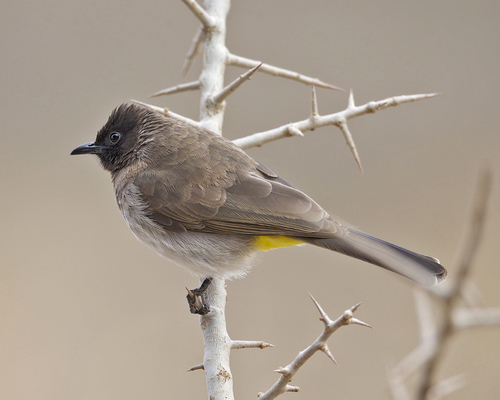
The common bulbul, scientific name Pycnonotus barbatus (Desfontaines, 1789), measures 18–20 cm (7.1–7.9 in) in length and has a long tail. Males and females have similar plumage, but males are on average larger than females. This species has a dark brown head, brown upperparts, and dull grey underparts. Its bill is fairly short and thin, with a slightly downward-curving upper mandible. The bill, legs, and feet are black, while the eye is dark brown with a dark but not easily visible eye-ring. Four subspecies — P. b. dodsoni, P. b. spurius, P. b. tricolor, and P. b. layardi — have yellow undertail coverts. The common bulbul's call is a loud doctor-quick doctor-quick be-quick be-quick. It is a common resident breeder across much of Africa, and has also been recorded breeding at Tarifa in southern Spain. It inhabits woodland, coastal bush, forest edges, riverine bush, montane scrub, mixed farming habitats, exotic thickets, gardens, and parks. Common bulbuls are usually seen in pairs or small groups. They are conspicuous birds that tend to perch at the top of bushes. Like other bulbul species, they are active and noisy. Their flight is bouncing and resembles the flight of a woodpecker.