About Pycnanthemum flexuosum (Walter) Britton, Sterns & Poggenb.
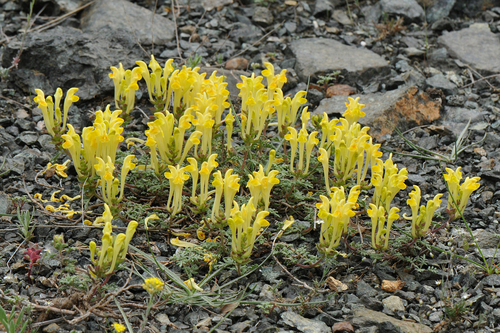
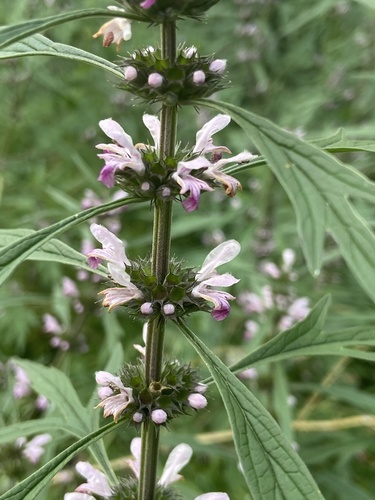
Pycnanthemum flexuosum grows from elongated rhizomes, producing erect, quadrangular, freely branched stems. Plants are canescent; stems reach 40–110 cm tall, with sharply to rounded angles. Its leaves are elliptic to elliptic-lanceolate, 1.5–5 cm long and 3–15 mm wide. Leaf tips are acute to obtuse, leaf bases are cuneate to rounded, and leaf stalks (petioles) measure 0.5–5 mm long. Leaf margins are crenate, with 1–4 teeth per side, and are rarely entire.
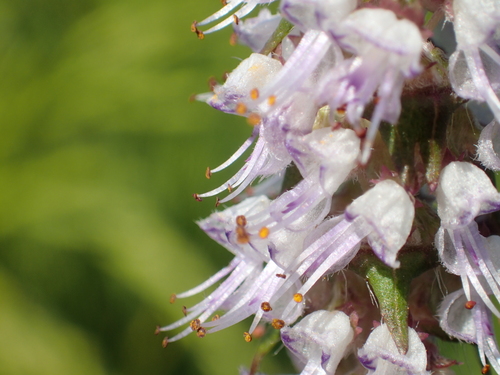
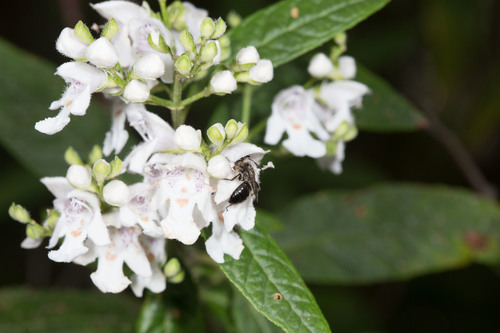
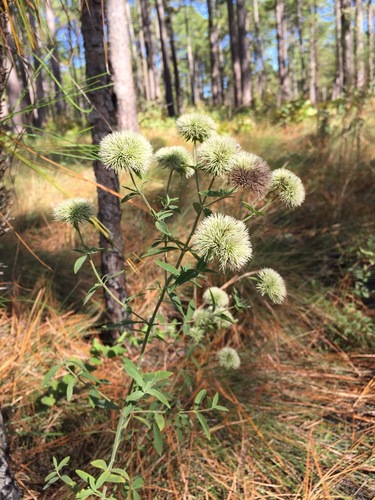
Inflorescences are made up of compact, often head-like small cymes (cymules) arranged in terminal thyrses. The full inflorescence forms flat-topped to high-domed heads 2–4 cm across, which become more open as fruit develops. Bracts are canescent, aristate, and often whitened. The calyx is five-toothed, ranging from zygomorphic to actinomorphic, and is slightly zygomorphic in this species, with a 4–4.8 mm long tube and white, acicular teeth 2.3–3.3 mm long. The corolla is zygomorphic and two-lipped: the upper lip is entire or notched, the lower lip is three-lobed. The corolla is white to lavender and 4–6 mm long. There are four usually exserted stamens, and an exserted, two-cleft stigma. The mature mericarps are dark brown, oblong-ovoid, 1–1.3 mm long, and have a long beard at the apex.
Pycnanthemum flexuosum is distributed from southeastern Virginia south to northeastern Florida, and west to the Florida panhandle and southern Mississippi. Disjunct inland populations also exist in southern central Tennessee, as well as in bogs and rock outcrops in southwestern North Carolina.