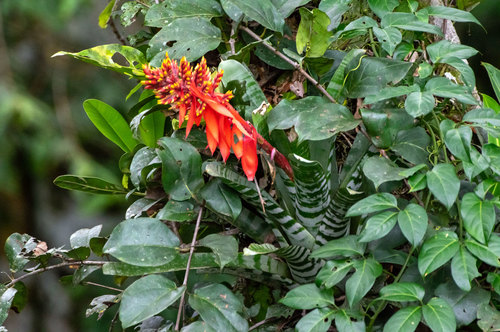
About Puya alpestris (Poepp.) Gay
Puya alpestris (Poepp.) Gay is a xerophytic perennial plant. It forms a dense rosette of leaves on a short stem. These leaves are tough, stiffly protruding, parallel-veined, end in a sharp point, grow to over 1 meter in length, and are 2 to 2.5 centimeters wide. Leaf margins are reinforced with hooked, curved spines around 0.5 cm long, and the underside of each leaf is covered in dense white scales. After many years of growth, the plant produces an upright, loose paniculate overall inflorescence, which is made up of numerous smaller racemose branching partial inflorescences. The lower third of these branches has stellate trichomes. The inflorescence holds many bright red bracts and many individual flowers, and the tips of the partial inflorescences are sterile. Flower stalks are approximately 7 mm long. The flowers are hermaphrodite and structured in groups of three. The three greenish sepals are around 2.3 cm long, and can be either hairy or smooth. The three teal petals with blunt tips are approximately 4.5 cm long, and spiral inward as the flower fades. The six stamens bear bright orange anthers. Puya alpestris flowers produce very high amounts of nectar. In its natural habitat, the plant blooms between October and December. During the flowering period, hummingbirds and other birds pollinate the flowers. After flowering, the plant develops capsule fruits, each containing many small, air-worthy seeds. Once seed development is complete, the mother plant dies slowly. The culpeo fox is known to feed on the large quantities of nectar Puya alpestris produces, and the fox likely acts as an additional pollinator for the species in the process.