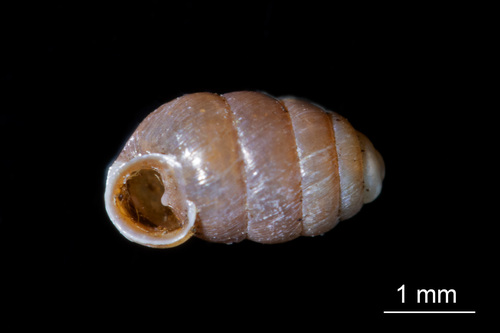
About Pupilla muscorum (Linnaeus, 1758)
This land snail species, Pupilla muscorum, has a shell that is usually light brown, with color ranging from reddish brown to horny grey. The shell is weakly striated or almost smooth, with 5 to 6.5 weakly convex whorls, and a suture that is not very deep (the related species Pupilla sterrii has a deep suture). The aperture of the shell usually has a well-developed lip, with a very strongly developed cervical callus that resembles a dam. A parietal tooth is usually present, and a palatal tooth is sometimes present as well. Pupilla muscorum lives sympatrically with Pupilla pratensis, and differs from that species by having a thicker, smaller, more slender shell, a lighter and more variable shell color, and a stronger apertural lip. The soft body of Pupilla muscorum is small and elliptical, dark with lighter sides and foot; the upper tentacles are not very long, and the lower tentacles are very short. Extant populations of P. muscorum have almost identical shell shape to their ancestors, which indicates that this species has tracked its preferred ecological niches over time. Shell height ranges from 3.0 to 4.0 mm, and shell width ranges from 1.65 to 1.75 mm, with little variation in shell diameter. Pupilla muscorum occurs across the Northern Hemisphere, including almost all of Europe. Confirmed records of its presence exist for Great Britain, Ireland, Austria, Vorarlberg, Germany, Bavaria, the Czech Republic, Slovakia, Ukraine, Crimea, Pakistan, and the US states of Michigan, Utah, and Vermont. In Britain, this species is threatened by disturbance from land use intensification on old calcareous grasslands. It is ranked as least concern in Austria and Germany, vulnerable in Vorarlberg, and has a decreasing population (ranked 4R) in Bavaria. Pupilla muscorum inhabits dry meadows, sand dunes, and other open, sunny habitats, and it is a calciphile (preferring calcium-rich environments). In Portugal, it is found under stones, among dead leaves, and in mosses. In Britain, it is common in sheep-grazed calcareous grasslands. Its elevation range extends up to 2400 m in the Alps, and up to 1200 m in Bulgaria. This species is ovoviviparous; it can hibernate while carrying its eggs, then release eggs that already contain partly grown embryos when more favorable seasons arrive.

