About Punica granatum L.
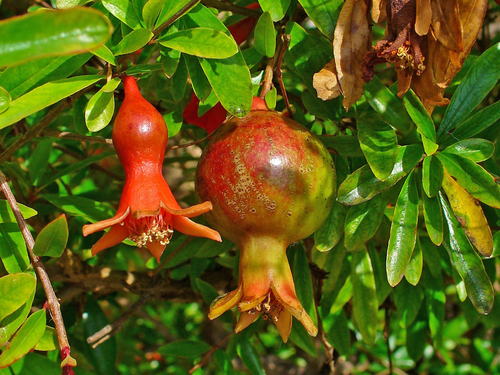
Punica granatum L., commonly known as pomegranate, is a spiny-branched shrub or small tree that grows between 1.5 and 5 meters (4 feet 11 inches to 16 feet 5 inches) tall. This species is long-lived; some individual specimens growing in France have survived for up to 200 years. Its leaves are opposite or subopposite, glossy, narrow oblong with entire margins, measuring 1.9 to 5 centimeters (0.75 to 1.97 inches) long and 0.8 to 1.5 centimeters (0.31 to 0.59 inches) wide. Pomegranate flowers are bright red or white, measure 3 centimeters (1 1/4 inches) or more in diameter, and bear between three and seven petals. Some fruitless cultivars are cultivated specifically for their ornamental flowers. Before anther maturity, the anthers remain closed around the stigma; internally, the ovaries are divided into specialized compartments called locules that hold many suspended ovules, separated by septa. P. granatum is cultivated both for its edible fruit crop, and as an ornamental tree or shrub for planting in parks and gardens. Mature specimens develop sculptural twisted bark, often have multiple trunks, and form a distinctive overall shape. Pomegranates are drought-tolerant, and can be grown in dry regions in either Mediterranean climates with winter rainfall or climates that receive summer rainfall. In areas with higher moisture, they are prone to developing root rot from fungal diseases. They can tolerate moderate frost, surviving temperatures down to approximately −12 °C (10 °F). Known insect pests of pomegranate include the butterflies Virachola isocrates, Iraota timoleon, and Deudorix epijarbas, as well as the leaf-footed bug Leptoglossus zonatus; unharvested ripe fruit also attracts fruit flies and ants. Pomegranate peels may be used to create dye for staining wool and silk in the carpet industry. Historically and traditionally, pomegranates were depicted on ancient coins of Judaea, including Hasmonean, Herodian, and First Jewish Revolt coinage. When not in use, the handles of Torah scrolls are sometimes covered with decorative silver globes shaped like pomegranates, called Torah rimmonim. It is traditional to eat pomegranates on Rosh Hashana, the Jewish New Year; the fruit’s many seeds make it a symbol of fruitfulness.