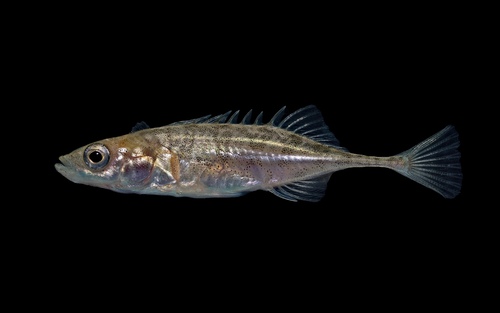
About Pungitius pungitius (Linnaeus, 1758)
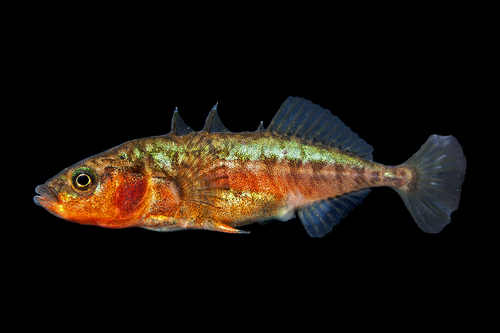
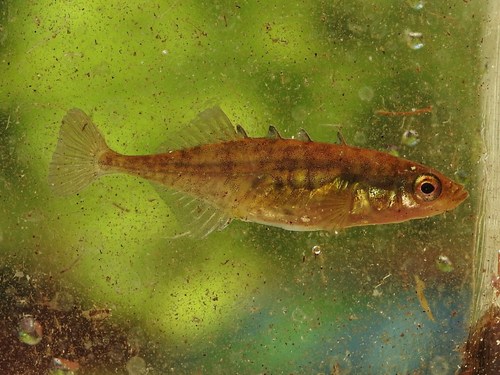
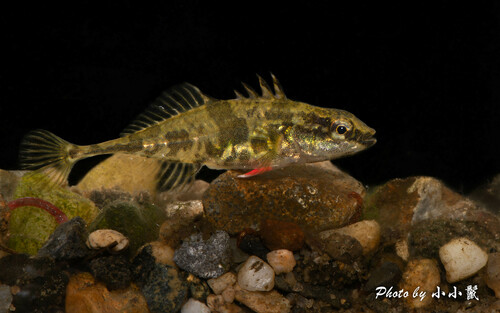
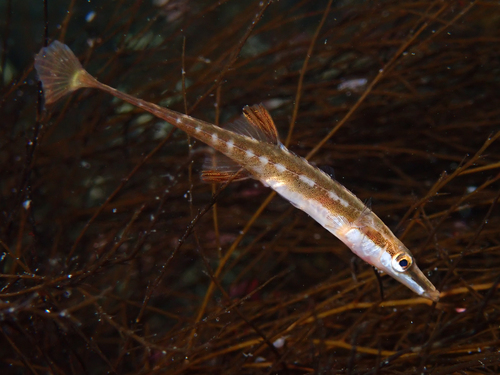
Pungitius pungitius, commonly known as the ninespine stickleback, is a small fish that reaches a maximum length of around 12.5 cm and a maximum age of about 3 years. Its body tapers to a very narrow caudal peduncle, and its caudal fin is fan-shaped. Compared to the three-spined stickleback, the ninespine stickleback has a less deep, more elongated body and a thinner, longer caudal peduncle. The clearest way to distinguish the two species is by the number of spines in front of the dorsal fin: for the ninespine stickleback, this number ranges from seven to twelve, with nine being the most common. This species lacks scales, but has a group of small bony plates on the narrowest part of the caudal peduncle at the lateral line. Its mouth is oriented upward. Its base color is generally greyish or olive-brown, with silvery flanks marked with irregular dark bars or blotches. During breeding season, males develop a black patch around the pelvis, and their pelvic spines turn white. Their eyes are dark, with a gold ring around the pupil. Ninespine stickleback inhabit streams, lakes, ponds and rivers, and prefer areas with thick submerged vegetation, as their small spines do not provide much protection. Like three-spined stickleback, ninespine stickleback have a series of bony scutes or plates along the lateral line; in freshwater populations, these plates are often fewer in number, with a gap between the anterior and posterior plates. This species occurs in freshwater systems that drain into the Arctic Ocean and Atlantic Ocean across Canada and Alaska, ranging south to New Jersey. It is also found on Alaska's North American Pacific coast, in the Great Lakes basin, and throughout most of Eurasia, including the United Kingdom, Greenland, Turkey, and the Far East.