About Punctelia rudecta (Ach.) Krog
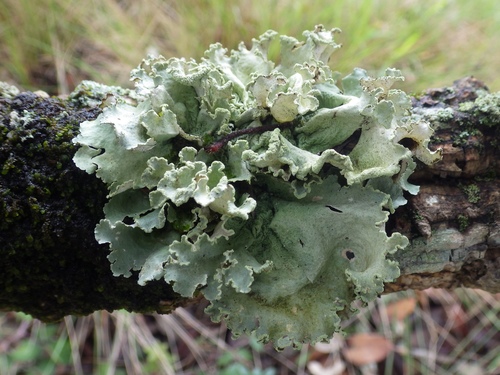
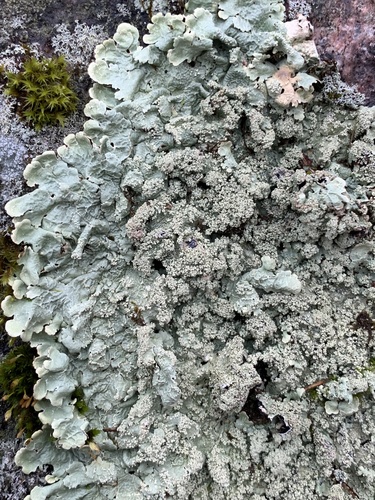
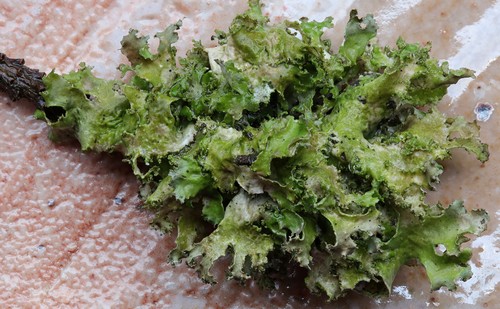
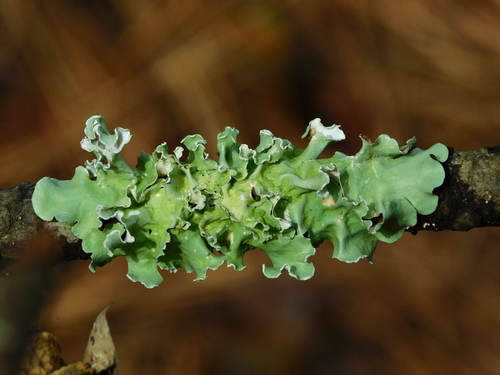
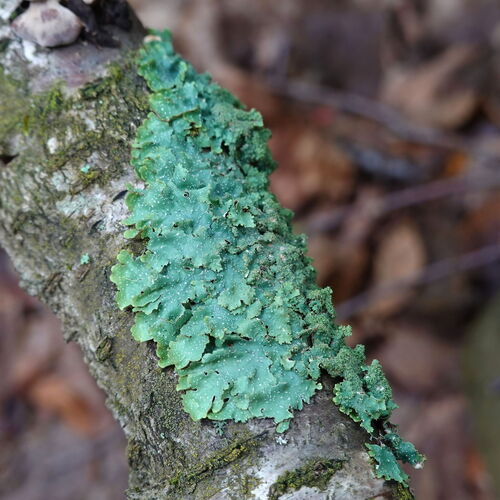
Punctelia rudecta (Ach.) Krog is a foliose lichen with a thallus that ranges in color from dark greenish-gray to almost blue-gray. Fresh thalli tend to be more gray-greenish, while dry thalli become more brown-yellowish. The thallus attaches relatively tightly to its substrate. The lobes that make up the thallus are mostly 3–8 mm (0.1–0.3 in) wide, and are more or less covered with cylindrical to branched isidia, which are typically more numerous toward the center of the thallus. Sometimes isidia become so dense that they form mounds that obscure the lobes underneath. Both lobe margins and isidia tips have a brown tinge, and bluish-green specimens with dense isidia can be easily spotted from a distance. White pseudocyphellae are usually prominent on the tips of the lobes. The lower surface of the thallus is tan, with pale rhizines. Apothecia are uncommon; when present, they reach up to 4 mm (0.16 in) in diameter, with a brown hymenium and a thin inward-rolled margin. Ascospores are ellipsoid, measuring 12.8–16 by 8–9.6 μm, and are non-septate, smooth, thin-walled, and hyaline. Its photosynthetic partner (photobiont) is the green alga Trebouxia anticipata. Standard chemical spot tests aid identification: in the medulla, results are PD-, K-, KC+ red, and C+ red; the C+ red result confirms the presence of lecanoric acid. The cortex contains atranorin, which produces a yellow K+ reaction. Punctelia rudecta has a temperate distribution in North America. While some popular North American lichen field guides’ range maps suggest it does not occur in the tropical climate of southern Florida, it was recorded in Fakahatchee Strand Preserve State Park in 2011. It is occasionally recorded in western North America, but much less frequently encountered there than in the east. It grows on all types of bark, or on shaded rocks. Irwin Brodo describes it as "one of the most common eastern isidiate foliose lichens", and Erin Tripp and James Lendemer similarly note its prevalence, calling it "arguably the weediest macrolichen east of the Mississippi River". Within its range, it grows in all types of forests and at all elevations. It occurs in most Canadian provinces: Manitoba, New Brunswick, Nova Scotia, Ontario, Prince Edward Island, Quebec, and Saskatchewan. It holds a national conservation status of "secure" in Canada, and is "secure" or "apparently secure" in all provinces except Saskatchewan, where its status is "critically imperiled". In Mexico, it has been reported from Distrito Federal, Chiapas, Veracruz, Jalisco, Baja California, Chihuahua, Durango and Sonora. Punctelia rudecta has an annual radial growth rate (expanding outward from the center) of about 5 mm (0.2 in) per year, which is similar to other foliose lichens in the family Parmeliaceae. Ovicuculispora parmeliae (previously called Nectria parmeliae) is a lichenicolous fungus that uses Punctelia rudecta as one of its many hosts. Laboratory studies have confirmed that this fungus cannot grow on Punctelia rudecta unless the lichen’s phenolic defense compounds are first removed. In nature, O. parmeliae can only grow on P. rudecta after an epiphytic Fusarium species, another inhabitant of the lichen, first enzymatically degrades lecanoric acid, P. rudecta’s primary lichen compound. Field studies show that lichens hosting O. parmeliae generally also host the Fusarium species. Other recorded fungal parasites growing on P. rudecta include Trichosphaerella buckii, Pronectria subimperspicua, and an unidentified Cladophialophora species. A New York-based study found that Punctelia rudecta provides shelter for several mite species, with Carabodes higginsi, Phauloppia banksi, and an undetermined Anachipteria species being the most numerous. The mites may help disperse the lichen’s spores. Punctelia rudecta can be used to create dye via color extraction with ammonia as a solvent; this method produces a pink color.