About Puma yagouaroundi (É.Geoffroy Saint-Hilaire, 1803)
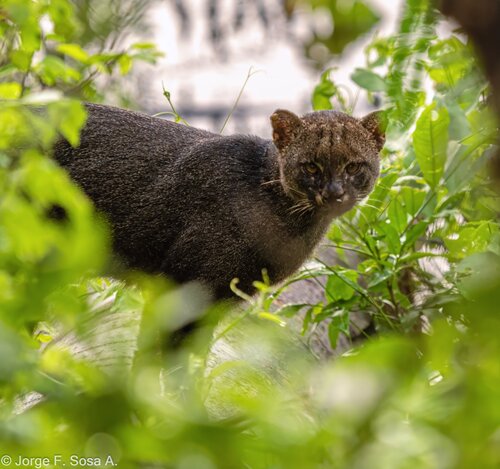
The jaguarundi (Puma yagouaroundi) is a medium-sized wild cat with a slender build and uniform coloration, whose external appearance differs greatly from other neotropical cats such as the small, spotted cats of the genus Leopardus. This distinctiveness has been linked to differences in its karyotype: the jaguarundi has 38 chromosomes, unlike the 36 chromosomes found in other small South American cats, and its chromosomal features are similar to those of Old World cats like the leopard cat (Prionailurus bengalensis). The diploid number of chromosomes in the jaguarundi is 2n=38. The jaguarundi shares several physical features with mustelids such as otters and weasels: it has an elongated body with relatively short legs, a small narrow head, small round ears, a short snout, and a long tail. Its head-and-body length ranges from 53 to 77 cm (21 to 30 in), and its strong muscular tail is 31–52 cm (12–20 in) long. Around twice the size of a domestic cat, the jaguarundi stands nearly 36 cm (14 in) tall at the shoulder and weighs 3.5–7 kg (7.7–15.4 lb), though larger individuals weighing around 9 kg (20 lb) have been recorded. Males are slightly larger than females. The jaguarundi's coat is uniformly colored, with at most a few faint markings on the face and belly; only young kittens have spotted coats for a short period. Clear black and white markings on the lips and snout, similar to those of cougars, are visible in juveniles and some adults. Two main color morphs are recognized, though intermediate shades also occur: a gray morph with blackish to brownish-gray fur that has a grizzled appearance from light and dark rings on individual hairs, and a red morph ranging from foxy red to chestnut. Early researchers considered these two morphs separate species, but individuals of both colors can be born in the same litter. Dark blackish brown jaguarundis look similar to tayras (Eira barbara), but tayras can be easily distinguished by their distinct yellowish throat patch. The red morph is more commonly found in dry, open areas. Melanistic individuals have been reported, but their coats are not completely black, and their head and throat are noticeably paler than the rest of the body. The jaguarundi's widely spaced ears are 2.5–4 cm (0.98–1.57 in) long, and have no spots on the back. The jaguarundi has a total of 30 teeth, with a dental formula of 3.1.3.1 / 3.1.2.1. Among felids, the jaguarundi is most closely similar in appearance to the flat-headed cat (Prionailurus planiceps), but has a longer body, proportionately longer legs, a heavier weight, and lacks the dark cheek markings found on the flat-headed cat. Tawny-colored jaguarundis have similar coloration to the larger cougar. The jaguarundi lives in a wide range of habitat types, including tropical rainforests, deciduous forests, deserts, thorn scrubs, cloud forests, mangroves, and savannas. Unlike the sympatric margay, ocelot, and oncilla, the jaguarundi can live in open areas. In open habitats, it prefers areas with vegetative cover such as cacti, which are generally difficult for potential predators to enter, and may have a few clearings at the edge of these areas. Jaguarundis typically stay close to a source of running water. The jaguarundi is known to tolerate environmental disturbance to its habitat, and can thrive in reforested areas. While it most commonly occurs from lowlands up to 2,000 m (6,600 ft) elevation, it has been recorded at elevations as high as 3,200 m (10,500 ft) in Colombia. Its distribution range extends from central Argentina in the south to northern Mexico, through Central and South America east of the Andes. Among cat species, only the cougar has a larger latitudinal distribution range. However, not all parts of the jaguarundi's range have been well studied. It is fairly common in Brazil, Peru, and Venezuela. It is possibly extirpated from the United States; a 1999 study rejected claims of jaguarundi sightings in Arizona's Huachuca Mountains, Santa Cruz County. The last specimen collected in the U.S. was a roadkill near Brownsville, Texas, in 1986. In 1994, researchers estimated that no more than 15 jaguarundis remained in the lower Rio Grande Valley, and their long-term survival there was considered doubtful. It was declared extinct in Texas in 2025, but is thought to still occur in Santa Ana National Wildlife Refuge. Jaguarundis have been sighted in Florida since the early 20th century. Their presence in Florida is traced to a writer from Chiefland who imported jaguarundis from their native range and released them near his hometown and at other locations across the state. No physical evidence of a Florida population exists, but many credible sightings have been reported starting in 1907. In 1977, W. T. Neill noted that reliable sightings had become less frequent and concluded the population had declined. Jaguarundis have also been reported in coastal Alabama since the 1980s, which may indicate the Florida population is migrating northward. The jaguarundi has also been recorded in Cerro Largo, Uruguay, where its presence was previously questioned. The jaguarundi is shy and reclusive, and appears to be very cautious of traps. Only a few radio telemetry studies of jaguarundis have been conducted, in Belize, Brazil, and Mexico. While jaguarundis have been observed active at any time of day or night, they appear to prefer hunting during daytime and evening hours. For example, a study in Belize found that jaguarundis began moving before dawn, remained active through most of the day until sunset, and had a hunting peak from late morning to noon. It is more diurnal than most other cat species, especially spotted cats that tend to be more active at night. The jaguarundi can swim across medium-sized rivers; one individual in Bolivia was recorded swimming across the Tuichi River. It is also an efficient climber, but hunts mainly on the ground, where its coat color provides good camouflage for terrestrial activity. It can leap up to 2 m (6 ft 7 in) into the air to catch birds. Recorded predators of jaguarundis include boa constrictors, cougars, and domestic dogs. Parasites including hookworms (Ancylostoma species), tapeworms (such as Spirometra and Toxocara species), and lung flukes have been found in jaguarundis. Most studies have observed jaguarundis alone or in pairs; pairs are likely a mother with older kittens, or two individuals of opposite sex during the mating season. Captive jaguarundis have been observed to be more gregarious. Jaguarundi home ranges are typically large. A study in Brazil recorded home ranges of 1.4–18 km2 (0.54–6.95 sq mi) for females, and 8.5–25.3 km2 (3.3–9.8 sq mi) for males. Two males in Belize had unusually large home ranges spanning 88 km2 (34 sq mi) and 100 km2 (39 sq mi), while a female in the same region had a home range of 13–20 km2 (5.0–7.7 sq mi). Population densities are typically low, ranging from 0.01 to 0.05 individuals per km2 (0.026 to 0.129 per sq mi) in Brazil, though densities as high as 0.2 individuals per km2 (0.52 per sq mi) have been recorded in Tamaulipas, Mexico, and the Llanos of Costa Rica and Venezuela. Marking behavior likely functions as a form of olfactory or visual communication between jaguarundis. Captive individuals have been observed scraping areas with their hind feet (sometimes combined with urination), clawing logs, rubbing their heads on objects, and leaving feces uncovered. Social behaviors including grooming, growling, and sniffing have been recorded. The jaguarundi has a broad vocal repertoire, with 13 distinct calls recorded: chattering, purring, screaming, a 'wah-wah' call, whistling, yapping, and a distinctive bird-like chirp. In captivity, females in estrus have been observed making faint sounds while scent marking their enclosure areas. Jaguarundis have been observed mating year-round, with breeding peaks occurring at different times of year across their range; for example, breeding peaks in January and March in Mexico. Estrus lasts three to five days, and is marked by the female regularly rolling onto her back and spraying urine. Sexually mature males pursue the female, and do not react to her aggressive behavior. As in many other felids, the male bites the fur on the female's neck when mounting, and the female lets out a loud scream during penetration. After a gestation period of 70 to 75 days, a litter of one to four kittens is born in a den built in dense thicket, a hollow tree, or similar cover. Kittens are born well-furred, and have spots on their underside that disappear as they age; their coat color gradually changes as they grow older. The mother starts bringing solid food to the kittens when they are around three weeks old, but the kittens only play with the food until the mother eventually eats it. Kittens are able to eat solid food such as birds and guinea pigs at around six weeks old. Jaguarundis reach sexual maturity at one to three years of age. A lifespan of up to 15 years has been recorded for captive jaguarundis.