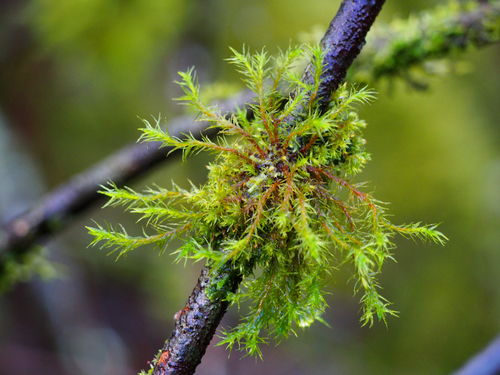
About Pulvigera lyellii (Hook. & Taylor) Plášek, Sawicki & Ochyra
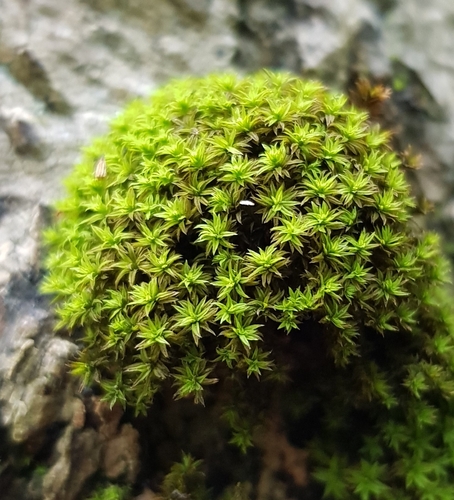
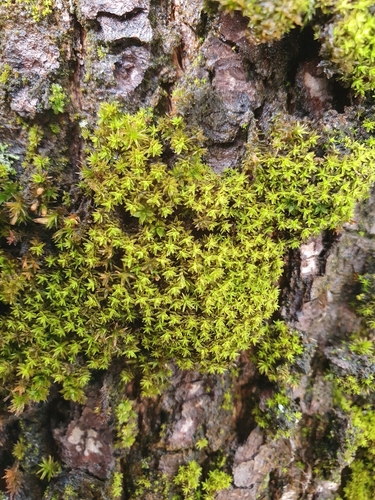
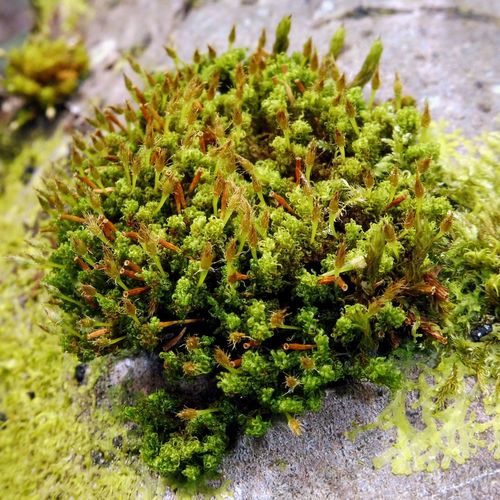
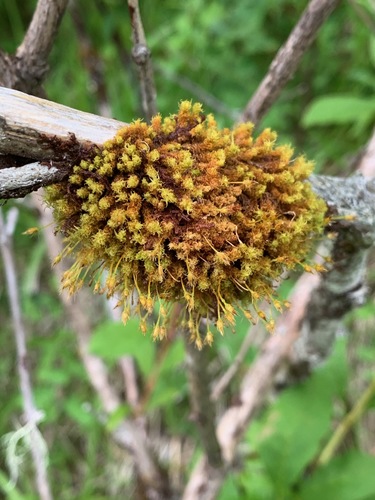
This species was previously known as Orthotrichum lyellii. It typically forms green and yellow mats, with loose tufts that grow 3 to 4 cm long and create mound-like structures. Tufts can sometimes reach 10 to 13 cm in length, and often grow prostrate along the ground. Its leaves are sharply pointed with a single costa, have a linear-lanceolate shape, are very slender, and measure 2.5 to 6.5 mm long. The lamina cells of its leaves are papillose. The entire leaf surface is often covered in brown asexual propagules called gemmae, a feature that helps distinguish this species from similar relatives like Orthotrichum papillosum. Pale-brown to brown rhizoids grow at the base of the plant; their branching varies, but is usually minimal. In North America, this species is primarily distributed west of the Rocky Mountains, ranging from southeastern Alaska to California. It is also found across Europe, extending from the United Kingdom south to the Mediterranean region of North Africa and into Western Asia. Its distribution is concentrated in low-elevation coastal temperate rainforests. It grows epiphytically on the trunks and branches of trees, occurring more frequently on deciduous trees including maple, alder, and oak, and less commonly on coniferous trees such as spruce and hemlock. It can occasionally be found growing on rocks or boulders underneath these trees, though this growth form is uncommon. Within its former genus, this species is unique for being dioicous: it produces archegonia and antheridia on separate individual plants. Male plants are smaller in size, and typically grow as small tufts near female plants. A distinct feature of male plants is the conspicuous bulb-like branches that hold their reproductive gametophores. Sporophytes are rare, with slightly exserted capsules that are usually immersed in perichaetial leaves. The sporangia is distinctive, marked by 8 ribs that may extend either halfway or the full length of the structure. Like most mosses in the class Bryopsida, this species has white arthrodontous peristome teeth, with 16 teeth present in both the exostome and endostome. Like many members of the former genus Orthotrichum, its calyptra is covered in straight hairs that run along its length and usually point toward its tip.