About Pultenaea juniperina Labill.
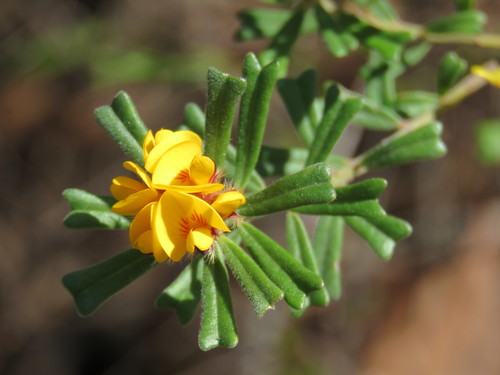
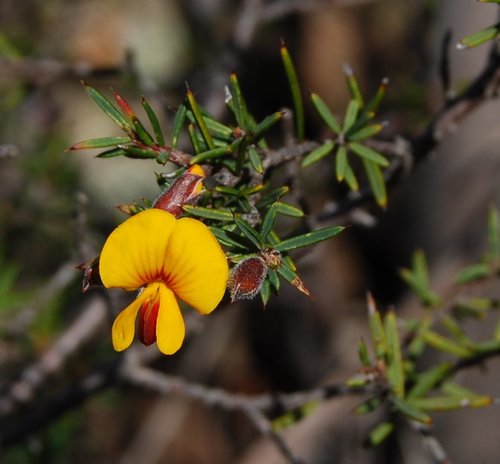
Pultenaea juniperina, commonly called prickly bush-pea, is an erect shrub that typically grows 1.2–3 m tall. Its young stems are covered with curled hairs. Leaves are arranged alternately, and vary in shape from linear, narrow elliptic, or narrow egg-shaped with the narrower end at the base, to lance-shaped. Leaves are often concave, usually heart-shaped at the base, and taper to a sharp pointed tip. Most leaves are 5–30 mm long and 1.5–2.5 mm wide, with a lance-shaped stipule 2–3 mm long at the base. The lower leaf surface is darker than the upper surface, and leaf edges are sometimes curved downwards.
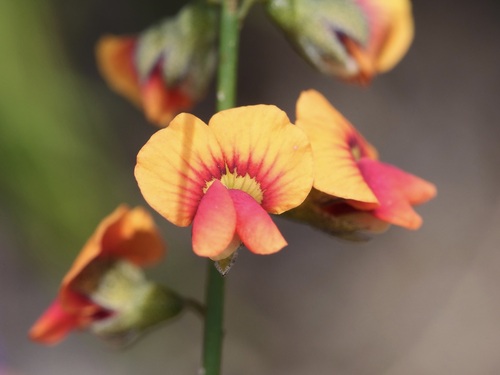
Flowers are 7–13 mm long, arranged singly or in clusters in leaf axils near the ends of short side-shoots. They are accompanied by egg-shaped, tapering bracts 2 mm long, and each flower grows on a 2–3 mm long pedicel. Sepals are 4–7 mm long, with lance-shaped bracteoles 1.5–3 mm long at their base. The standard petal is yellow to orange with red striations, the wing petals are yellow to orange, and the keel petal is yellow with a red tip or entirely red. Flowering takes place from October to November, and the fruit is a hairy pod whose lower half remains enclosed by the remains of the sepals.
This species is endemic to south-eastern Australia, where it grows in forest, woodland, and heath. In New South Wales, it is found in the Armidale area, and along the coast and tablelands south of the Brindabella Range; this range includes the Australian Capital Territory and Kosciuszko National Park. In Victoria, Pultenaea juniperina is treated as a separate species from Pultenaea forsythiana. If records for Pultenaea forsythiana are included under Pultenaea juniperina, the species is widespread across the southern half of Victoria. Pultenaea juniperina is widespread in Tasmania.