About Pulsatrix perspicillata (Latham, 1790)
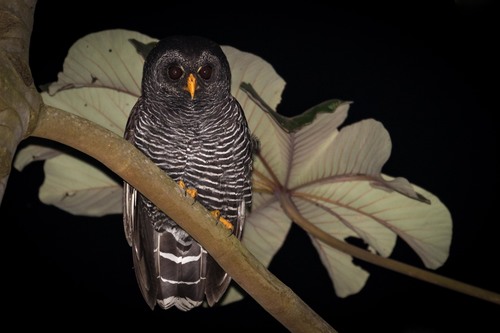
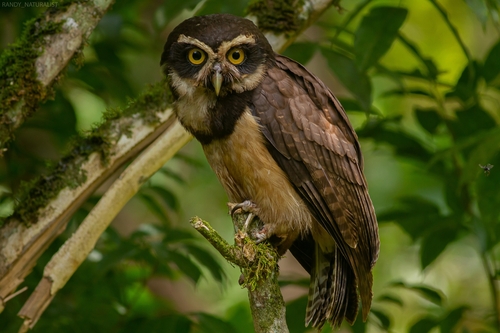
The spectacled owl (Pulsatrix perspicillata) measures 41 to 52.3 cm (16.1 to 20.6 in) in total length. Males weigh between 453 and 1,075 g (1.00 to 2.37 lb), while females weigh 680 to 1,250 g (1.50 to 2.76 lb). A sample of 10 males from the nominate subspecies (P. p. perspicillata) had an average weight of 767 g (1.69 lb), and 8 sampled females from this subspecies averaged 908 g (2.00 lb). Across most of its range, this species is easily identifiable; it can only be confused with other owls in the genus Pulsatrix. It has blackish brown upperparts, head and upper breast, white facial markings, and whitish to yellowish-ochre underparts. Its eyes are yellow, making it the only Pulsatrix species with this eye color, and its beak is pale. Juvenile spectacled owls are even more distinct than adults: they are completely white except for a chocolate brown facial disc. The head is typically darker than the back and mantle, and variation in the shade of this area, along with the composition of the breast band, is the main external feature that distinguishes its different subspecies. Compared to the closely related band-bellied owl (P. melanota), the spectacled owl is similar in or slightly larger in size. The band-bellied owl has dark eyes, white eyebrows, a brown chest band broken by buffy-whitish barring, and mostly whitish underparts with additional reddish-brown barring. The spectacled owl generally occurs at lower elevations than the band-bellied owl, but their ranges overlap or lie adjacent to each other from Colombia to northern Bolivia. The tawny-browed owl (P. koeniswaldiana), found from northeastern Argentina to eastern Brazil, is fairly similar in appearance to the spectacled owl, but is noticeably smaller, has ochraceous-tawny plumage from the eyebrows down to the belly, and has dark chestnut eyes. Each of the three currently recognized Pulsatrix species also has a unique song. Spectacled owls are most vocally active on calm, moonlit nights. The primary call of the spectacled owl is made up of guttural knocking or tapping sounds with a popping quality, commonly described as patterns such as PUP-pup-pup-pup-po, POK pok pok bog bog bog bobobo or BOO Boo boo boo boo. In this call, each subsequent note becomes weaker, lower in pitch, and faster as the call progresses. Males are the primary singers that use the call to proclaim territory, and they often sing from the upper third of a tall tree. Females also sing the same song, but deliver it at a higher pitch. Pairs have been recorded performing duets on moonlit nights. Females also produce a hawk-like scream with a drawn-out emphasis on the second syllable, transcribed as ker-WHEEER, which is often compared to the sound of a steam whistle. Young spectacled owls beg for food with a harsh, high-pitched keew call. One author noted that in Colombia, the spectacled owl’s song has a similar tapping pattern to that of the great spotted woodpecker (Dendrocopos major). In Brazil, this species is known locally as "knocking owls". The spectacled owl is distributed across Mexico, Central America (including Belize, Guatemala, El Salvador, Honduras, Nicaragua, Costa Rica, Panama), Trinidad and Tobago, and South America (including Colombia, Venezuela, Suriname, French Guiana, Guyana, Paraguay, Ecuador, Peru, Bolivia, Brazil, Argentina). It is primarily a tropical rainforest bird, and occurs most often in areas with abundant dense, old-growth forest. It may enter secondary habitats such as forest edges, especially while hunting. On rare occasions, it has been found in dry forests, treed savanna plains, plantations, and semi-open areas that have scattered trees. In regions like Costa Rica, it may inhabit subtropical montane cloud forests up to 1,500 m (4,900 ft) in elevation, though the species is generally associated with lowland forests. In Costa Rica, spectacled owls may lay eggs at any point from the dry season (November to May) to the start of the wet season (June to July). This owl typically nests in an unlined tree cavity, but may also use the crook of a large tree where branches meet the trunk. Like all owls, it does not build its own nest, so it lays its eggs directly on the bare wood surface, which is usually rotting wood in the case of tree cavities. Spectacled owls lay 1 to 2 eggs, which are incubated entirely or almost entirely by the female for around 5 weeks. If both eggs hatch, often only one chick will survive: the smaller chick usually dies from starvation or from aggression by the larger nestling. Chicks leave the nest to climb onto surrounding branches at around 5 to 6 weeks old, but are usually not able to fly well at this stage. They remain dependent on their parents for food and care for several months after leaving the nest, and may continue to be cared for up to a year after fledging. This extended care period can prevent the breeding pair from producing new young the following year. Spectacled owls may breed while they still have immature plumage, as full adult plumage can take up to five years to develop.