About Pulmonaria officinalis L.
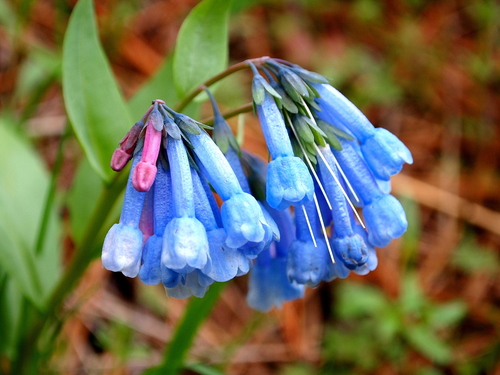
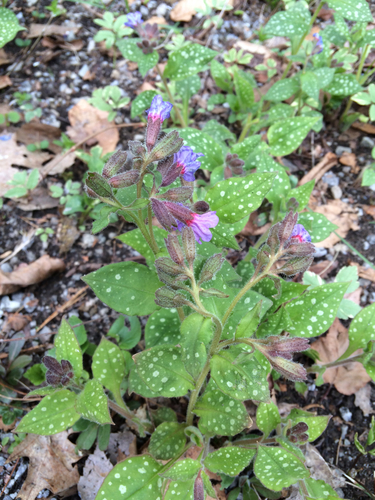
The basal leaves of Pulmonaria officinalis L. are green, cordate, more or less elongated and pointed, and always marked with rounded, often sharply defined white or pale green patches. The upper leaf surface is covered in tiny bumps and is quite hairy. This plant acts as a host, and its leaves are eaten by caterpillars of the moth Ethmia pusiella. In spring, the plant produces small clusters of flowers. The five-petaled flowers start out red or pink, and later turn blue-purple as anthesis progresses, driven by a change in pH inside the petals. The flowers contain an anthocyanin dye that shifts color from red in acidic conditions to blue in alkaline conditions. Pulmonaria officinalis is a diploid species with a chromosome number of 2n = 14. Its flowering period runs from March to May, and seeds ripen between May and June. Pollination occurs via insects, a method called entomophily, with main pollinators including bees, bumblebees, and butterflies, and seeds are spread by ants. This native species is one of the most widespread plants in Europe. Its distribution extends west through the Ardennes to the Netherlands, Denmark, and southern Sweden. It is not present in Norway, and is only naturalized rather than native in the British Isles. Its range reaches east to central Russia and the Caucasus, and it grows in the Balkans as well as northern to central Italy. Pulmonaria officinalis is an understory species. It grows in deciduous and beech mixed forests from lowlands to mountain areas. It favors fresh, shady locations, and nutrient-rich, mostly calcareous, stony or pure clay loam soils, at altitudes between 0 and 1,500 meters (0 to 4,921 feet) above sea level. As a spring geophyte, it begins its vegetative growth before the tree canopy fully leafs out. During this early period, it is exposed to high solar radiation, which creates potential risk for the plant. After trees leaf out, the level of solar radiation reaching the plant decreases. This species is adapted to these changing light conditions with effective protective and repair mechanisms, including specific morphological leaf characteristics, epidermal structure, and UV-B absorbing substances. After full tree foliation, the amount of photosynthetic pigments in the plant's leaves increases slightly because less sunlight is available. In contrast, levels of UV-B absorbing substances, specifically flavonoids and anthocyanins, drop significantly after foliation.