About Pulchriphyllium bioculatum (Gray, 1832)
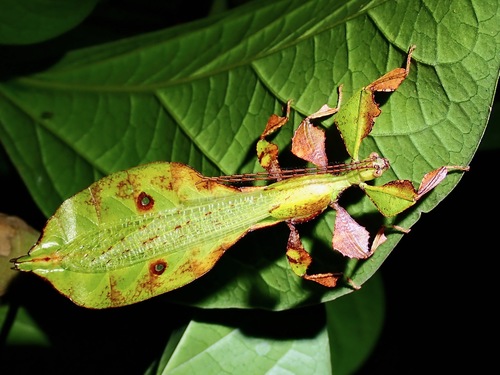
Pulchriphyllium bioculatum (Gray, 1832) is a species of leaf insect. This insect has a broad green body and legs, and frequently has spots. Both females and males can appear in shades of green, yellow, and orange. Males measure 50 to 68 millimetres (2.0 to 2.7 in) in length, while adult females measure 67 to 94 millimetres (2.6 to 3.7 in) in length. Female antennae are very short, while male antennae are longer. Females are heavy-bodied and flightless: their hind wings are unused, while males use their hind wings for flying. This species uses forewings and camouflage for defense. The abdomen is narrower at the base, and the femur of the fore legs is dilated. Young Pulchriphyllium bioculatum are about 20 millimetres (0.79 in) long, dark red in colour, and exhibit reflex immobility. This species molts 5–6 times over its lifetime. Females lay approximately 500 eggs total over their lifetime. These leaf insects are found mainly in tropical areas and rainforests, where sufficient vegetation is available for them to eat. Earlier classification, which grouped the now separate species Pulchriphyllium pulchrifolium, Pulchriphyllium scythe, and Pulchriphyllium crurifolium with this species, led to the assumption that P. bioculatum had a very large distribution area, thought to extend west to the Seychelles and Mauritius, east and south to Malaysia, Sumatra, and Java, and north through India and Sri Lanka to China. Previously recorded locations such as Borneo, Singapore, Madagascar, and Mauritius actually host other related species. Currently, animals classified as P. bioculatum are only found on Sumatra, the islands off Sumatra's coast (including Bangka Island and Belitung), and the southern part of the Malay Peninsula. However, the IUCN Red List considers this species endemic to the Seychelles, holding that Asian records refer to other species. The species prefers a temperature of 24–28 °C (75–82 °F); nighttime temperatures can drop by 2–3 °C (3.6–5.4 °F). Temperature does not strongly affect the species overall, but lower temperatures will slow its development. Temperatures should not drop below 22 °C (72 °F), and low humidity can cause stress and death for the species. P. bioculatum are slow-moving herbivores that rely on their camouflage and forewings to defend against predators including birds, amphibians, and reptiles. Females live 4 to 7 months, while males live 3 weeks to 1 month. Females can reproduce via parthenogenesis, a form of asexual reproduction, so many eggs they lay are unfertilized. Females lay around 100 eggs at intervals of a few days, and can lay up to three eggs per day. Eggs are beige-brown, oval or barrel-shaped (similar to seeds), and measure about 6–7 mm (0.2–0.3 in). This species catapults its eggs using a backward movement of the abdomen; one study found that the ratio of the thrown egg's distance to the insect's body length was between 24 and 36, when compared with some other species. At 25 °C (77 °F), fertilized eggs incubate for 3–4 months, while unfertilized eggs incubate for 6 months. Overall incubation for this species at 25 °C ranges from 5–7 months. Unfertilized eggs hatch only into females, while fertilized eggs can hatch into either males or females. Newly hatched larvae are red, and turn green within three to seven days.

