About Puffinus puffinus (Brunnich, 1764)
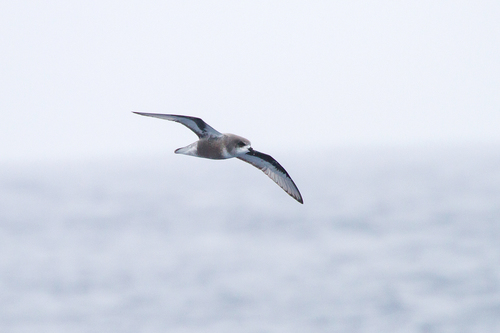
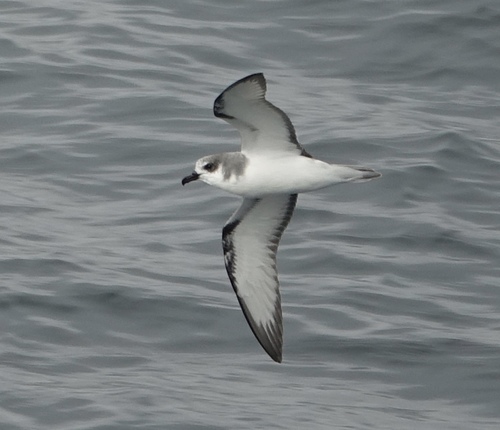
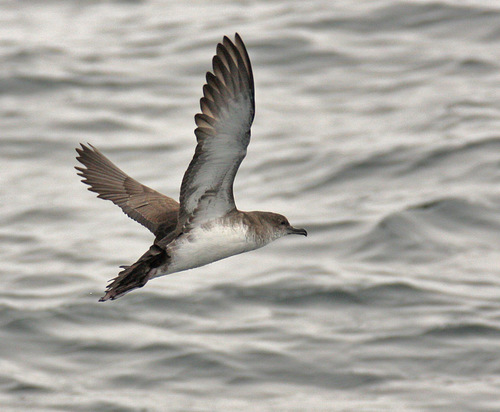
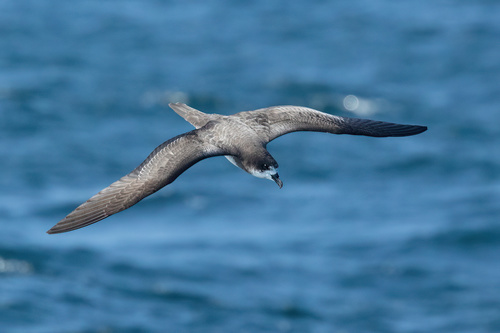
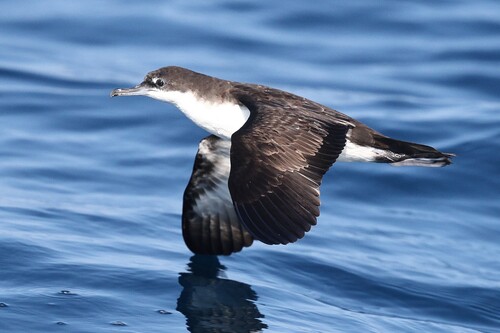
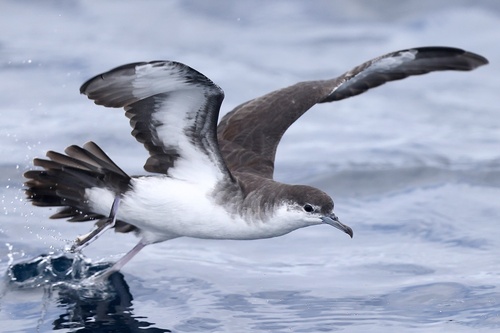
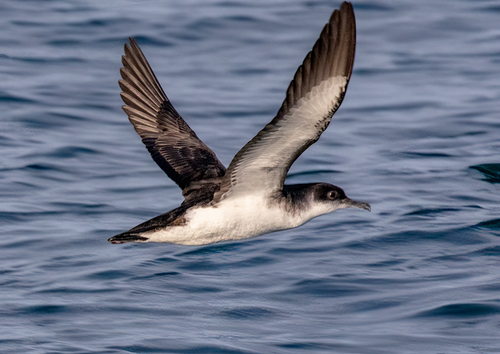
The Manx shearwater (Puffinus puffinus (Brunnich, 1764)) measures 30–38 cm (12–15 in) in length, has a 76–89 cm (30–35 in) wingspan, and weighs 350–575 g (12+1⁄2–20+1⁄2 oz). It has the characteristic "shearing" flight common to its genus: it glides dipping side to side on stiff wings with few wingbeats, with its wingtips almost touching the water. Its wings are held at right angles to its body, giving it the shape of a flying cross. As it travels low over the sea, it alternates exposing its black upperparts and white undersides, so it appears to change color from black to white. This species is entirely marine, and typically flies within 10 m (30 ft) of the sea surface. It nests in burrows on small islands, which it only visits at night. Its nesting colonies are located in the North Atlantic Ocean, in the United Kingdom, Ireland, Iceland, the Faroe Islands, France, the Isle of Man, the Channel Islands, the Azores, the Canary Islands, and Madeira. The most important colonies, holding a total of more than 300,000 pairs, are found on islands off Wales, Scotland, and Northern Ireland. Three-quarters of all British and Irish Manx shearwaters breed on just three islands: Skomer, Skokholm, and Rùm. Around 7000–9000 pairs breed in Iceland, and at least 15,000 pairs breed on the Faroe Islands. All other remaining populations have at most a few hundred pairs. The species has recently colonized northeastern North America, ranging from Newfoundland and Labrador to Massachusetts. Although breeding was first recorded here in 1973, populations remain small. Sightings of Manx shearwater in the northeast Pacific are increasing, and breeding has been suspected in British Columbia and Alaska. During the breeding season, these birds regularly commute between their nesting colonies and offshore feeding grounds that can be up to 1,500 km away. For example, adult Manx shearwaters rearing chicks on the west coast of Ireland have been observed to travel all the way to the Mid-Atlantic Ridge to feed when conditions are suitable. Manx shearwaters leave their breeding colonies from July to March, when they migrate to the South Atlantic to winter, mainly off the coasts of Brazil and Argentina, with smaller numbers wintering off southwest South Africa. Juvenile Manx shearwaters complete their first migration without guidance from their parents. Only a few days after leaving the nest, these young birds can already travel up to 2000 km. The southward migration journey can be over 10,000 km (6,000 mi), which means a 50-year-old bird has likely covered over a million km (600,000 mi) from migration alone. This migration appears to be quite complex, including many stopovers and foraging zones throughout the Atlantic Ocean. Ornithologist Chris Mead estimated that a bird ringed in 1957 at approximately 5 years old, and still breeding on Bardsey Island off Wales in April 2002, had flown over 8 million km (5 million mi) in total over its 50-year life. Manx shearwaters are able to fly directly back to their own burrows even when released hundreds of kilometres away, even when released inland. The Manx shearwater feeds on small fish including herrings, sprats, and sand eels, as well as crustaceans, cephalopods, and surface offal. It catches food from the water surface or by pursuit diving, and forages either alone or in small flocks. It can be drawn to areas where cetaceans are feeding, but it rarely follows boats or associates with other shearwater species. As a tube-nosed seabird, it can detect food items from several tens of kilometres away using its sense of smell. It picks up scents from offal and compounds such as dimethyl sulfoxide, which is produced when krill consume phytoplankton. These shearwaters track across the wind until they encounter a food scent, then follow it upwind to its source.