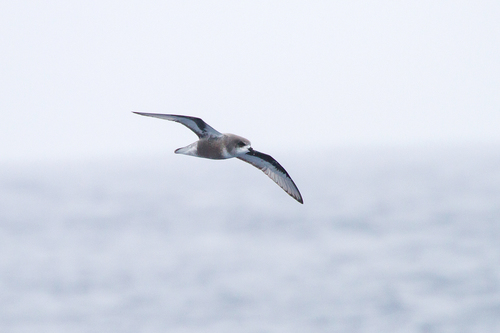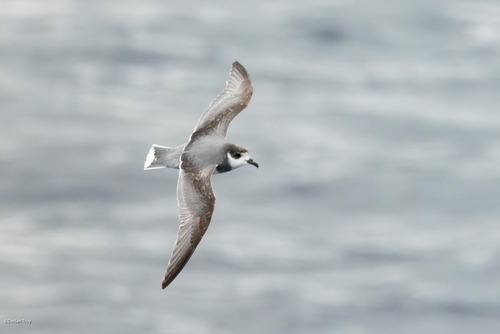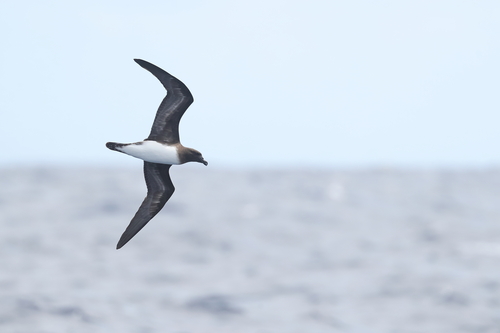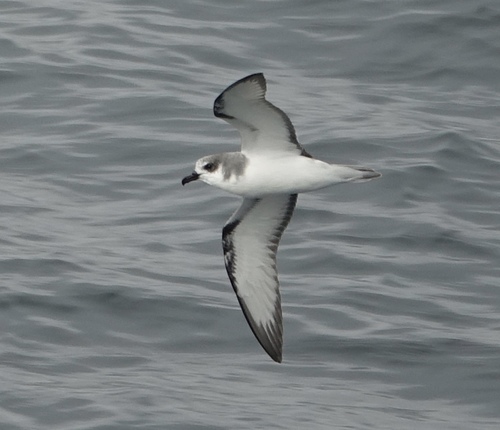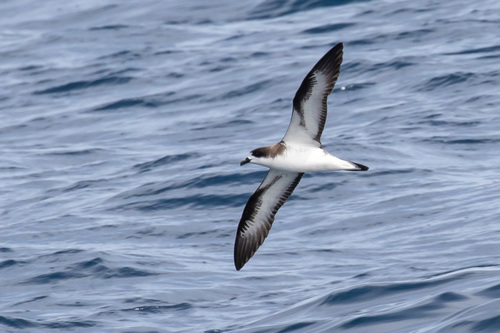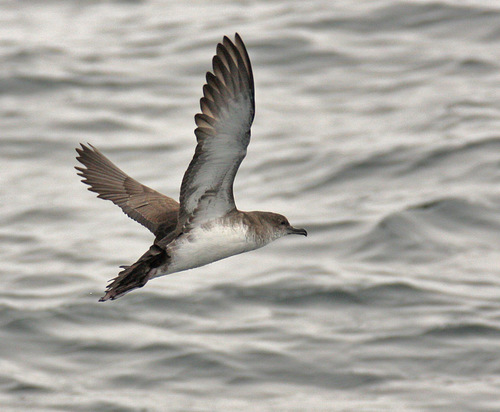
About Puffinus opisthomelas Coues, 1864
Identification: Adult black-vented shearwaters measure 30–38 cm in length, have a 76–89 cm wingspan, and weigh approximately 400 g. Males are usually slightly larger than females, with only minimal size difference between the sexes. Habitat and Distribution: This is a pelagic species that lives in the Pacific Ocean and the Gulf of California. It comes closer to shore than most other shearwaters. It nests mainly on offshore islands off north and western Baja California, Mexico. Specifically, 95% of the entire nesting population breeds on Isla Natividad, with smaller breeding groups on Isla de Guadalupe and Islas San Benito. The species is relatively common off the coast of central and southern California during colder months. It has recently been observed nesting on Isla Rasa and Isla Partida in the Gulf of California, which represents an expansion of its previously known breeding range. Black-vented shearwaters have been seen as far north as British Columbia, but they are classified as accidental visitors to this area. They prefer warmer waters, reported to be above 14 °C, but are relatively flexible in their habitat choices and foraging strategies. The species primarily lives in waters above the continental shelf. Near breeding colonies, the sea floor drops sharply farther from the coast, and some individuals are thought to forage in waters more than 2 kilometers deep. This species does not migrate long distances, and generally stays relatively close to its breeding colonies year-round. Behaviour and Ecology: Black-vented shearwaters are nocturnal, and their activity levels are affected by ambient light. This behavior is thought to be an adaptation to avoid predation by diurnal predators such as the Western Gull (Larus occidentalis), as the species experiences its highest predation rates during daylight hours. Reproduction: Black-vented shearwaters nest in colonies. Colony sizes have not been accurately estimated to date, but around 95% of the entire breeding population has historically been located on Isla Natividad. During the breeding season, black-vented shearwaters dig burrows that they maintain for the full breeding period. It is not confirmed exactly when they dig burrows, but research indicates this happens between late November and January. These burrows are typically built in sandy soil in areas with sparse low vegetation. On San Benito Island, shearwaters often build nests in existing rock crevices. The species will also use artificial burrows when they are available. Clutches usually contain one egg. Occasionally two eggs have been found in a single nest; this is most likely the result of another female laying an extra egg in the nest, or one of the eggs being a leftover egg from a previous breeding season. Both parents spend roughly equal amounts of time incubating the single egg. Incubation shifts average between three and five days each. The total incubation period lasts approximately 49 days. Newly hatched chicks are altricial and cannot regulate their body temperature, so they require substantial parental care.