About Puffinus lherminieri Lesson, 1839
The Sargasso shearwater (Puffinus lherminieri Lesson, 1839) has an average length of 30 cm (12 in) and an average weight of 170 g, making it roughly half the size of the great shearwater (Puffinus gravis). There is measurable size and weight variation between different populations, with the full normal range falling between 30–33 cm (12–13 in) in length and 150–230 g (5.3–8.1 oz) in weight. Its wingspan measures 64 to 72 centimetres (25 to 28 in), its tail is around 8.5 centimetres (3.3 in) long, its exposed culmen is 3 centimetres (1.2 in) or slightly shorter, and its tarsus is approximately 4 centimetres (1.6 in) in length.
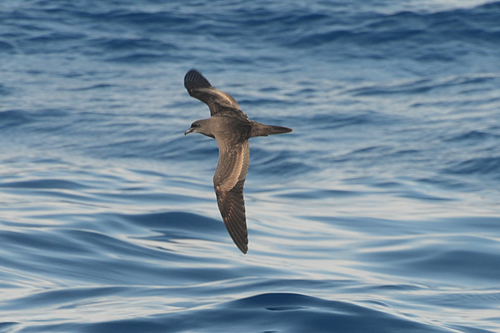
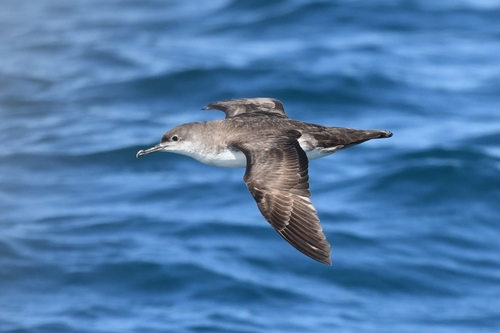
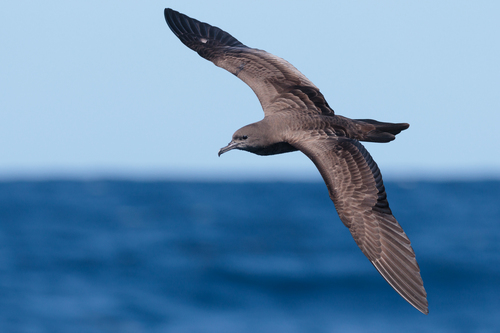
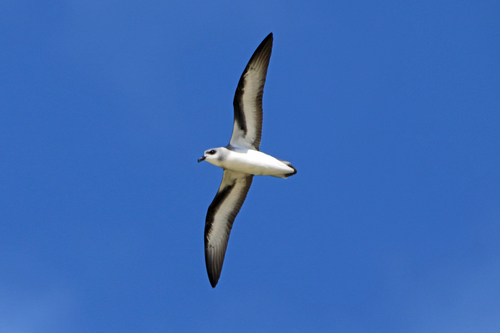
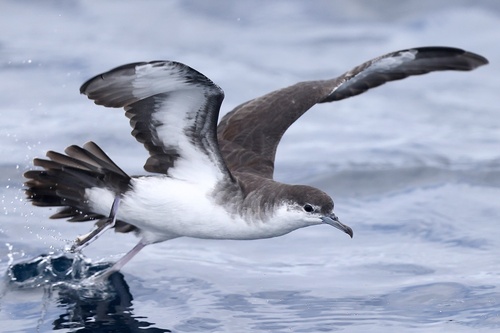
Overall, this is a small shearwater with black upperparts and white underparts, and is hard to tell apart from its close relatives at first glance. Its upperparts, rectrices, and undertail coverts are blackish-brown, as are at least the distal undersides of its remiges, and sometimes the entire remige feathers. All other underparts are white, and the area of the head below eye level is also white. The iris is dark, the feet are dull pink with a black wash and black toenails, and the bill is grey with a pinkish hue, darker towards the tip. Males and females have identical plumage. Immature birds do not have a distinct plumage separate from adults, while nestlings are fully covered in down: grey on the upperparts and whitish on the belly.
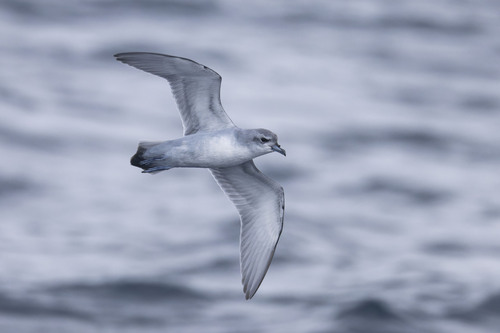
The Sargasso shearwater can be confused with the Manx shearwater (P. puffinus), which differs by having white undertail coverts and a longer bill when compared directly. Most other similar-looking species are generally completely allopatric to the Sargasso shearwater, though the largely subantarctic little shearwater (P. assimilis) may occasionally range into waters normally occupied by P. lherminieri. The little shearwater differs from the Sargasso shearwater by having more white on the face and underwing, a smaller bill, and greyish-blue feet. The Sargasso shearwater's twittering and mewing calls are most often only heard at night when the birds are in breeding colonies.
The Sargasso shearwater breeds primarily on islands in the Caribbean and Lucayan Archipelago. During the non-breeding season, it ranges across the northwestern Atlantic Ocean, and is particularly found along the Gulf Stream and in the Sargasso Sea. It adapts well to a range of preferred marine habitats, and can be found in pelagic, offshore, and inshore waters. It uses a variety of feeding methods: it mainly dives into water from flight, plunges underwater from a floating swimming position, and less frequently picks up food from less than a bill's depth underwater while "pattering" as if walking across the surface of the waves. Its diet consists of small fish, squid, and planktonic crustaceans. Unlike many other shearwaters, it does not commonly follow ships, though it may gather around small fishing boats; it can also sometimes be found as part of mixed-species feeding flocks.
This species is colonial, and nests in small burrows and rock crevices on atolls and rocky islets, located on earthy slopes. The timing of the breeding season varies by location and subspecies, though the exact details of this variation have not been well-studied. Both parents share incubation duties for the single white egg that the species lays; measurements for one average-sized specimen record the egg as 52.5 by 36.2 mm and weighing 37 g. Each parent takes incubation shifts lasting 2 to 10 days, and the egg hatches after 49–51 days of total incubation. Nestlings are brooded for three and a half to seven days, after which parents leave the nestling alone in the burrow for most of the time, spending most of their time foraging to feed the voracious offspring, which becomes very fat before fledging. The period from hatching to fledging lasts 62–75 days. The Sargasso shearwater takes approximately 8 years to reach breeding age. As is typical for Procellariiformes, this species is long-lived for its body size; one individual ringed as an adult was recaptured alive 11 years later, meaning it was more than 15 years old at that time. While some small local populations are threatened, the species as a whole (when considered unsplit in the present taxonomic sense) is not considered globally threatened.