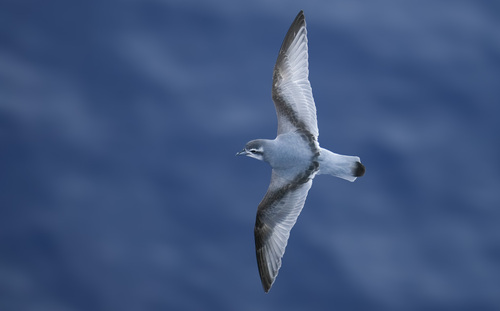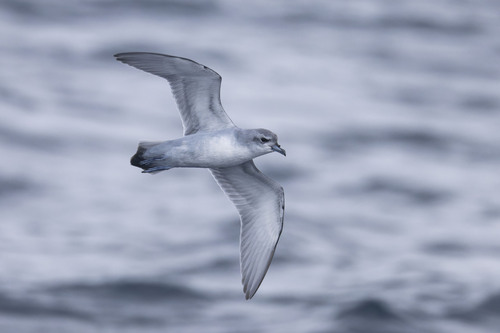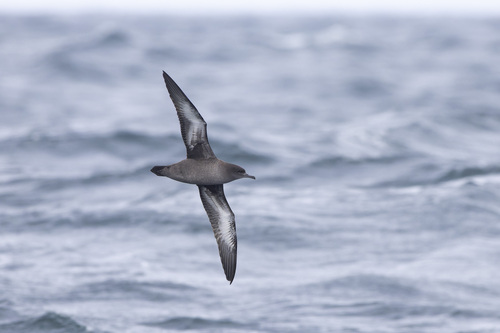
About Puffinus griseus (Gmelin, 1789)
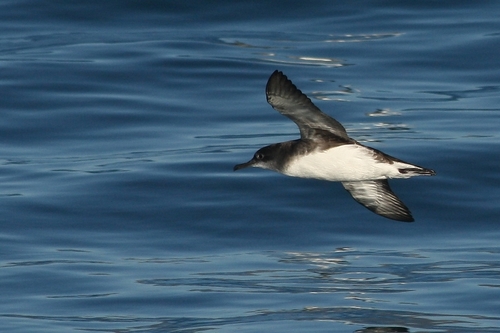
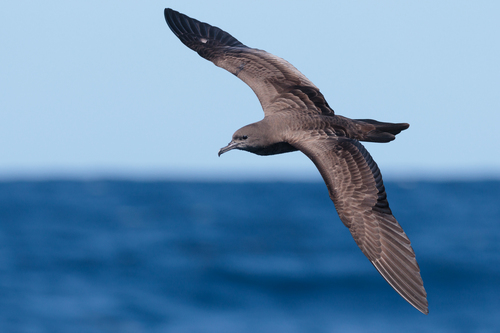
Sooty shearwaters (Puffinus griseus) measure 40–51 cm (16–20 in) in length, with a wingspan of 94–110 cm (37–43 in). They have the characteristic "shearing" flight of their genus: they dip from side to side on stiff wings with few wing beats, and their wingtips almost touch the water. Their flight is powerful and direct, with wings held stiff and straight, which gives them the appearance of a very small albatross. This species gets its name from its diagnostic dark plumage. In poor viewing conditions, it appears entirely black, but in good light it shows as dark chocolate-brown, with a silvery stripe along the center of the underwing. Sooty shearwaters are vocal at night on breeding grounds, where they typically produce loud coos and croaks. They are usually silent when at sea, but may call when competing for food in large groups. In the Atlantic, this is the only all-dark large shearwater, though it can be confused with the smaller, usually paler Balearic shearwater at long range; Balearic shearwaters lack the pale underwing stripe found on sooty shearwaters. In the Pacific portion of sooty shearwater range, other all-dark large shearwaters occur. In particular, short-tailed shearwaters are almost impossible to distinguish from sooty shearwaters when seen at a distance.
Sooty shearwaters breed on small islands, split into two main populations. One population is in the South Pacific, with breeding grounds mainly around southeast Australia, New Zealand, the Auckland Islands, and Phillip Island off Norfolk Island. The second is in the South Atlantic, breeding on the Falkland Islands, Tierra del Fuego, and Tristan da Cunha. Sooty shearwaters begin breeding in October, and incubate their young for approximately 54 days. After a chick hatches, its parents raise it for 86 to 109 days.
This species is known for impressive long-distance migrations, which follow a circular route. At the end of the nesting season in March–May, they travel north up the western sides of the Pacific and Atlantic Oceans. They reach subarctic waters in June–July, where they cross from west to east, then return south down the eastern sides of the oceans in September–October, arriving back at breeding colonies in November. Migratory flocks numbering hundreds of thousands of individuals have been observed in Monterey Bay, California. In June 1906, two sooty shearwaters were shot near Guadalupe Island off Baja California, Mexico, several weeks before the main bulk of the population would pass the area. Similarly, the identity of numerous large dark shearwaters observed in October 2004 off Kwajalein in the Marshall Islands remains unclear; they could have been either sooty or short-tailed shearwaters, but neither species is generally known to pass through this region at that time of year. In the Atlantic Ocean, sooty shearwaters travel over 14,000 km (8,700 mi) from their breeding colony on the Falkland Islands (52°S 60°W) north to 60 to 70°N in the North Atlantic off northern Norway. Distances traveled in the Pacific are similar or larger; although Pacific breeding colonies are not quite as far south, lying at 35 to 50°S off New Zealand before moving north to the Aleutian Islands, the greater longitudinal width of the Pacific requires longer migrations. Recent tagging experiments have shown that birds breeding in New Zealand may travel 74,000 km in a year, reaching Japan, Alaska, and California, and average more than 500 km per day. In Great Britain, sooty shearwaters move south in late August and September; during strong north and north-west winds, they may occasionally become trapped in the shallow, largely enclosed North Sea. When this happens, passage of a few, or exceptionally up to a thousand birds per day, may be seen flying back north up the British east coast as they retrace their path back to the Atlantic over northern Scotland.
The sooty shearwater feeds on fish and squid. It can dive up to 68 m deep to catch food, but more often takes food from the surface, and frequently follows whales to catch fish disturbed by the whales. It also follows fishing boats to scavenge fish scraps thrown overboard. Isotopic analyses have found significant niche overlap between sooty shearwaters and great shearwaters. Sooty shearwaters breed in huge colonies; females lay one white egg, which averages 48 mm (1.7 in) wide and 77.5 mm (3.1 in) long. They nest in burrows lined with plant material, which are only visited at night to avoid predation by large gulls and skuas. Burrow architecture can vary within and between breeding colonies, influenced by competition for breeding space and habitat type; soil under dense tussac grass is easier to excavate than other substrates. In New Zealand, the indigenous Māori population harvests around 250,000 sooty shearwater chicks each year for muttonbird, which is used for oil and food. Young birds that are nearly ready to fledge are collected from burrows, plucked, and often preserved in salt. In 2022, climate change was found to be impacting this cultural harvest by Ngāi Tahu. Sooty shearwater numbers have declined in recent decades, and the species is currently classified as near threatened by the IUCN.