About Puffinus gravis (O'Reilly, 1818)
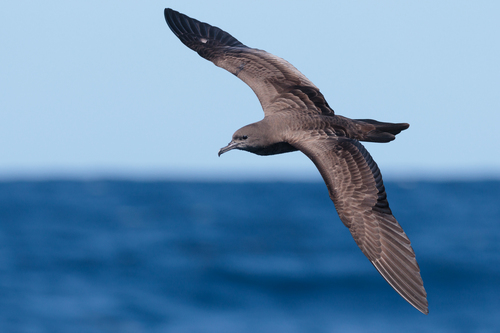
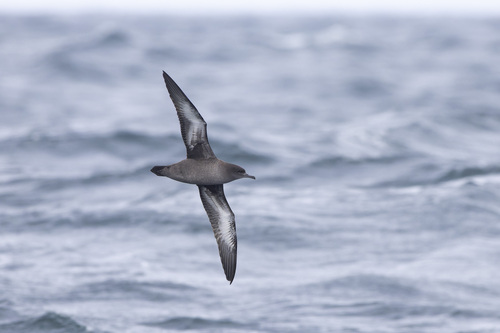
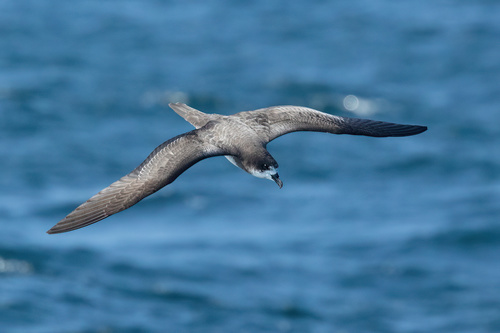
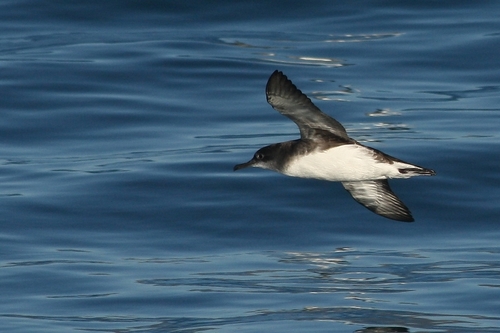
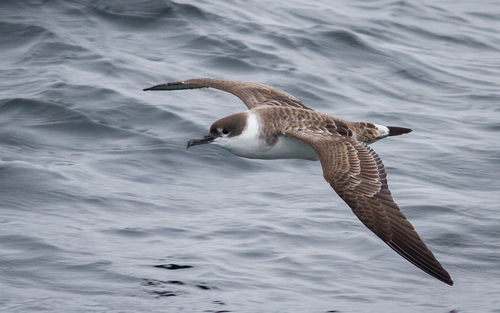
This shearwater measures 43 to 51 cm (16.9 to 20.1 in) in length, with a wingspan of 105 to 122 cm (3.5 to 4.0 ft). It can be identified by its size, dark upperparts, and white underparts, which are distinct except for a brown belly patch and dark shoulder markings. It has a black cap, a black bill, and a white horseshoe-shaped marking at the base of the tail. Its stiff flight, similar to that of a large Manx shearwater, is also a distinctive feature. Within its range, the only other large shearwater species are Cory's Shearwater and the all-dark Sooty Shearwater. Like the sooty shearwater, the great shearwater follows a circular migration route: it moves north up the eastern seaboard first of South America, then of North America, before crossing the Atlantic Ocean in August. It can be quite common off the southwestern coasts of Great Britain and Ireland before heading back south, traveling down the eastern littoral of the Atlantic on this return journey. This species shows the characteristic shearing flight common to its genus: it dips from side to side on stiff wings with few wingbeats, with its wingtips almost touching the water. Its flight is powerful and direct, with wings held stiff and straight. The great shearwater feeds on fish and squid, which it catches from the water surface or by plunge-diving. It will occasionally feed on crustaceans, fish entrails, and other refuse discarded by fishing vessels. It readily follows fishing boats, where it engages in noisy squabbles over food. This is a gregarious species that can be seen in large numbers from ships or suitable headlands. When resting in groups on the water, it usually gives a piercing eeyah cry. Great shearwaters are among the seabird species with the highest rate of plastic ingestion.