About Puffinus gavia (J.R.Forster, 1844)
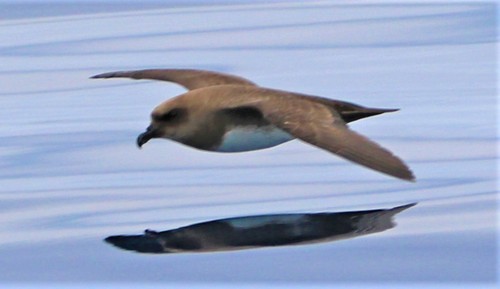
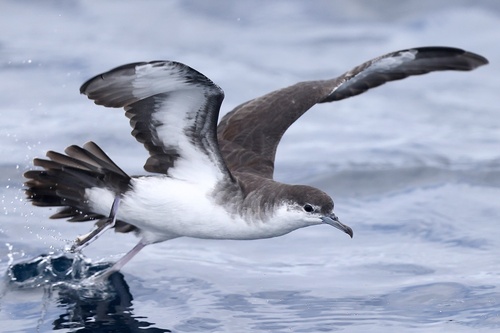
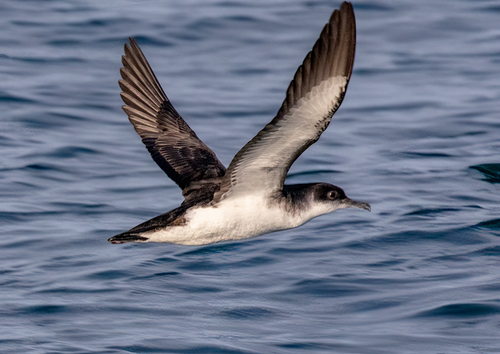
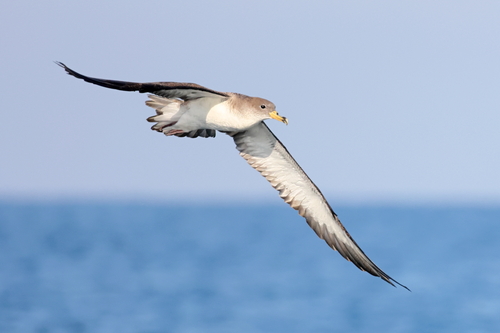
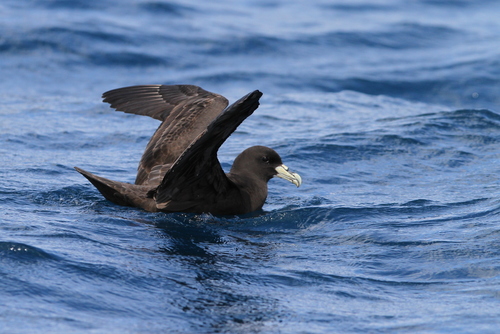
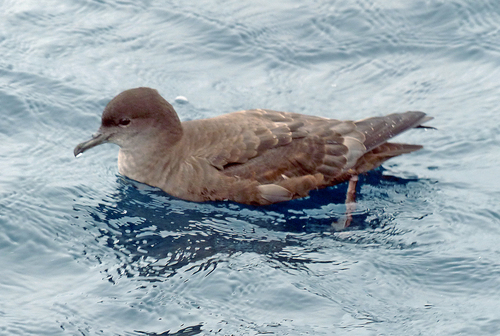
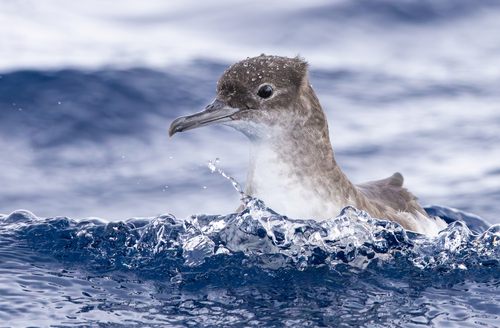
Puffinus gavia, commonly called the fluttering shearwater, is a small to medium-sized shearwater with a dark brown and white body. Its upperparts, including the neck, wings, and tail, are uniformly dark brown. The face and upper neck are grey-brown, fading gradually to white below the eye. The underbody, from the chin to undertail coverts, is white, save for a dark thigh patch visible when the bird is in flight. The underwing is usually white, while the axillary area is covered in grey-brown feathers. Legs and feet are pinkish-brown with dark webbing, and the feet extend past the tail during flight. The bill is long, thin, and dark. The short, fan-shaped tail shows a mix of dark brown and white in flight. Moulting begins in late January, and dark upper surfaces quickly fade to mid-brown. Birds nearing moult, from February to April, are pale rusty brown and appear ragged. The species’ call is an unusual, disjointed ka-hek-ka-hek-ka-hek, typically given in flight. Its flight is low and fast, consisting of rapid bursts of wingbeats alternating with gliding. Average body mass is 302 g (10.7 oz) for females and 243 g (8.6 oz) for males. Eggs are pure white and oval-shaped. Juveniles already match the adult coloration when in the nest, but have paler edges on their wing coverts. Nestlings have thick, soft slate-coloured feathers on their upperparts and white down on their underparts. The fluttering shearwater is endemic to New Zealand. It breeds there during the warmer months from September to February. During the non-breeding season between March and August, large numbers of the species are observed along eastern and south-eastern Australia, though most individuals remain near their New Zealand breeding colonies. It is suspected that only juveniles migrate while adults stay in New Zealand’s productive waters, but this has not been confirmed. In New Zealand, fluttering shearwaters breed on coastal islands across the country. Large breeding populations are found on north-eastern North Island islands including the Aldermen Islands, Moturoa Island, Bream Islands, north-west Chicken Islands, Mercury Islands, and Motuharakeke Island in the Cavalli Islands. They also breed on islands throughout the Marlborough Sounds and Cook Strait region of the South Island. Most breeding islands are offshore and located within 40 km of the New Zealand mainland. Fluttering shearwaters occupy both marine and terrestrial habitats, including coastal marine areas, scrubland, and forest. They are most often found in subtropical waters at around 24 °C with intermediate to high salinity of approximately 35%. They are common in accessible inshore areas such as harbours, inlets, bays, and straits. For breeding, they typically choose stony, scrub-covered slopes near hill peaks, as well as rock cracks and holes located far from the water, which gives them clear space for takeoff.