About Puffinus carneipes Gould, 1844
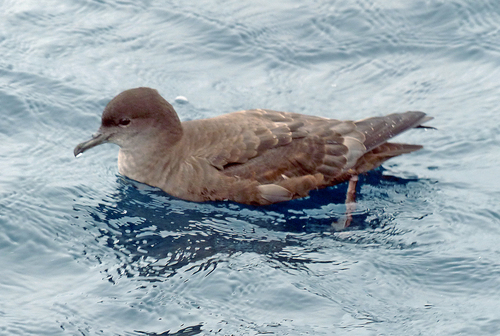
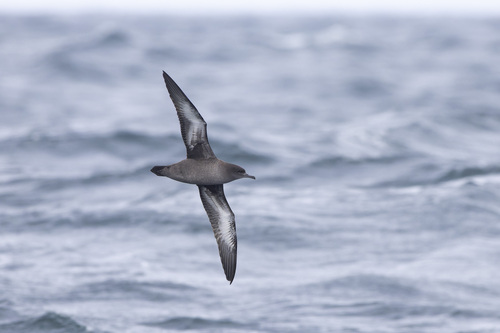
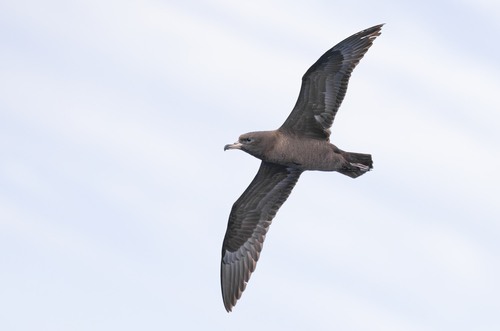
The flesh-footed shearwater (scientific name Ardenna carneipes, originally published as Puffinus carneipes Gould, 1844) is a medium-large shearwater that primarily inhabits the Indo-Pacific region. Its plumage is entirely black, with pale pinkish feet and a pale bill that has a distinct black tip. Along with the similarly light-billed pink-footed shearwater, it forms the Hemipuffinus group, a superspecies that may or may not share an Atlantic relative with the great shearwater. These large shearwaters are among the species that have been reclassified into the separate genus Ardenna. Recent genetic analysis shows strong genetic divergence between Pacific colonies of the species and colonies located in South and Western Australia. This divergence is thought to be caused by philopatry and differences in breeding-season foraging strategies. A 2021 molecular phylogenetic study detected very little genetic difference between the flesh-footed shearwater and the pink-footed shearwater (Ardenna creatopus). The study's authors suggested that these two taxa would be better classified as a single conspecific species. The flesh-footed shearwater breeds in colonies, with two main breeding regions. The first, in the southwest Pacific Ocean, includes Lord Howe Island (22,654 breeding pairs), South Australia (around 1,800 breeding pairs across two islands), and northern New Zealand (13,000 breeding pairs). The second breeding population holds no more than 36,000 breeding pairs spread across 42 islands along the Western Australian coast, from Cape Leeuwin to the Recherche Archipelago. An additional 500 pairs breed on St Paul Island in the Indian Ocean. A report of the species occurring on Pakistan's Astola Island in the Arabian Sea remains unconfirmed. Recent evidence indicates that the species' population is declining across most of its range. It is currently listed as Near Threatened in Australia, and nationally Vulnerable in New Zealand. It has also been recommended for listing under the Agreement on the Conservation of Albatrosses and Petrels. At the subnational level in Australia, the species is listed as Vulnerable in Western Australia and New South Wales, and Rare in South Australia. The flesh-footed shearwater visits the North Pacific Ocean as a boreal summer visitor. In this region, potentially large numbers of the species are caught as bycatch in commercial fisheries. The species is also threatened by climate change impacts and significant heavy metal contamination. The cause of this contamination is not fully understood, but it is likely the result of the birds ingesting large quantities of plastic that they mistake for food floating on the ocean surface.