About Puffinus assimilis Gould, 1838
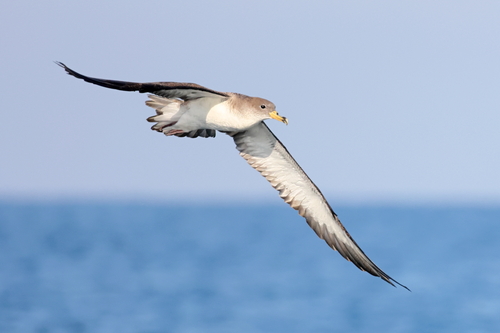
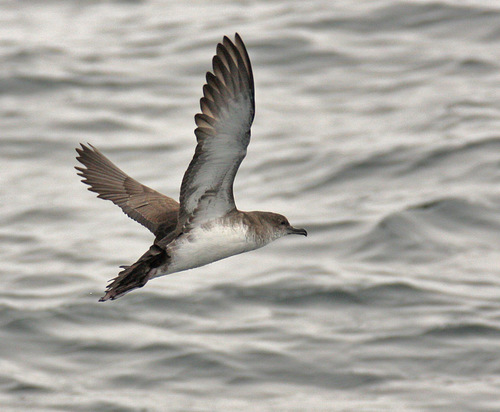
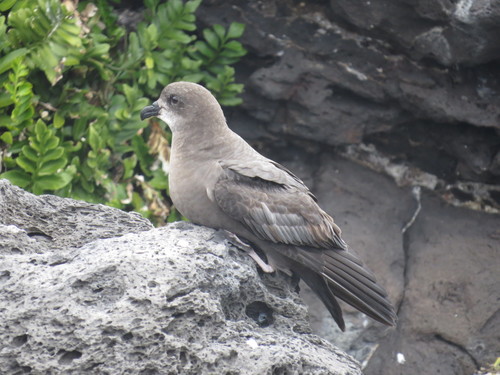
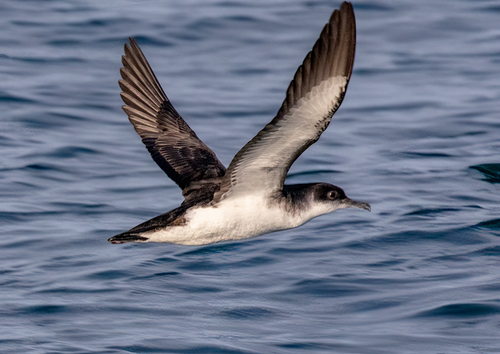
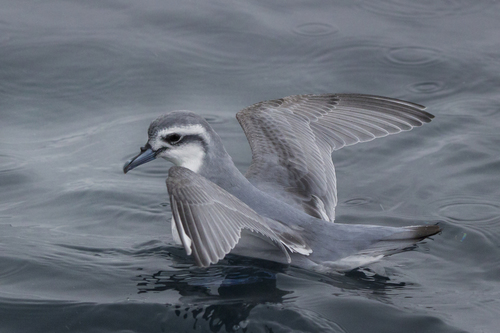
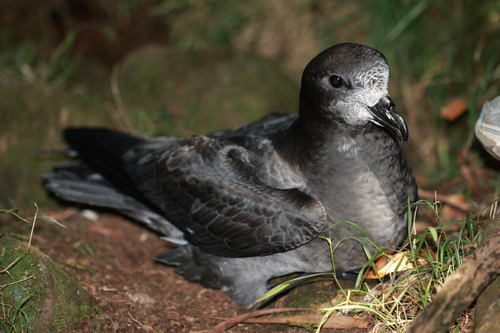
This species, the little shearwater Puffinus assimilis Gould, 1838, shares the characteristic "shearing" flight of its genus. It glides from side to side on stiff wings with few wing beats, and its wingtips almost touch the water. In light winds, however, its flight includes more flapping than the flight of its larger close relatives. In flight, the bird appears cross-shaped, as it holds its wings at a right angle to its body. When it flies low over the sea, it alternately exposes its black upperparts and white underparts, so its overall colouration appears to shift between black and white. It measures 25–30 cm (9.8–11.8 in) in total length, with a wingspan of 58–67 cm (23–26 in). It resembles a small Manx shearwater, but has proportionally shorter and broader wings, with a pale patch on its inner flight feathers. Its bill is more slender than the bill of a Manx shearwater, and its dark eye contrasts clearly with the white feathering that surrounds it. Four subspecies are currently recognized, each with a distinct distribution: P. a. assimilis Gould, 1838 is found on Lord Howe Island and Norfolk Island; P. a. haurakiensis Fleming, CA & Serventy, 1943 is found in northeastern North Island, New Zealand; P. a. kermadecensis Murphy, 1927 is found on the Kermadec Islands; and P. a. tunneyi Mathews, 1912 is found on islands off the southwestern coast of Australia. This shearwater breeds in colonies on islands and coastal cliffs. It nests in burrows, which it only visits at night to avoid predation by large gulls.