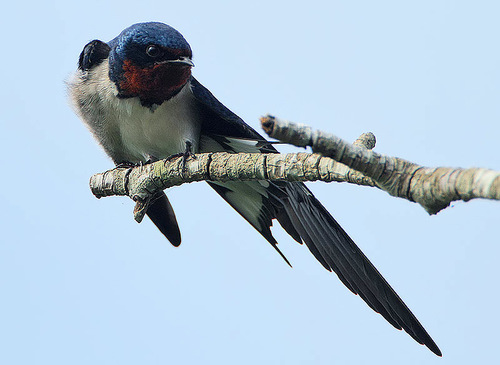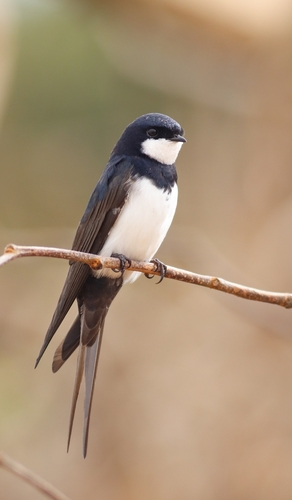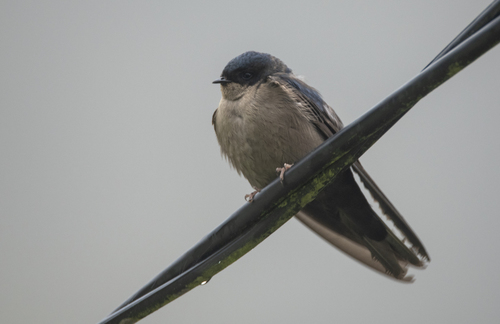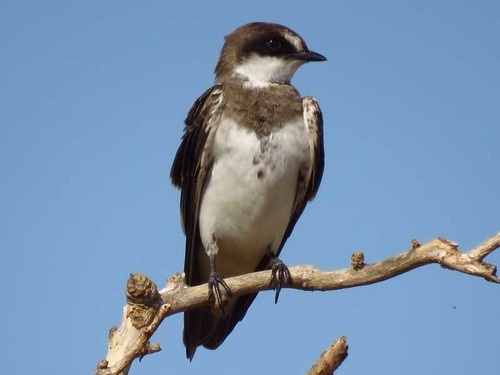
About Ptyonoprogne rupestris (Scopoli, 1769)
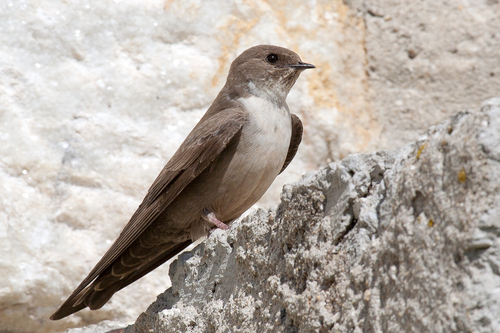
The Eurasian crag martin, Ptyonoprogne rupestris, measures 13–15 cm (5.1–5.9 in) in length, has a wingspan of 32–34.5 cm (12.6–13.6 in), and weighs an average of 23 g (0.81 oz). It has ash-brown plumage on its upperparts and paler plumage on its underparts, with a broader body, wings, and tail than any other European swallow. Its tail is short and square, with white patches near the tips of all feathers except the central and outermost pairs. The underwing and undertail coverts are blackish, the eyes are brown, the small bill is mainly black, and the legs are brownish-pink. Adult males and females look identical, while juveniles have buff-brown tips on the plumage of the head, upperparts, and wing coverts.
This species can be told apart from the sand martin by its larger size, white tail patches, and lack of a brown breast band. Where its range overlaps with other Ptyonoprogne species, the Eurasian crag martin is darker, browner, and 15% larger than the rock martin, and larger and paler (especially on the underparts) than the dusky crag martin. Its white tail spots are also notably larger than the spots of both related species.
Compared to other swallows, the Eurasian crag martin has a relatively slow flight. It alternates rapid wing beats with flat-winged glides, and its long flexible primaries give it the agility to manoeuvre close to cliff faces. Average migration flight speed has been measured at 9.9 m/s (32.5 ft/s), which is slower than the roughly 11 m/s (36 ft/s) typical for other hirundines, though available data is limited. The bird often flies at height, and displays its white spots when it spreads its tail. Its vocalisations include short high pli calls, plus piieh calls that resemble linnet calls and tshir calls that resemble house martin calls.
The Eurasian crag martin breeds in mountain regions stretching from Iberia and northwesternmost Africa through southern Europe, the Persian Gulf, and the Himalayas to southwestern and northeastern China. Northern populations are migratory: European birds winter in north Africa, Senegal, Ethiopia, and the Nile Valley, while Asian breeding birds travel to southern China, the Indian subcontinent, and the Middle East. Some European birds remain north of the Mediterranean, and like martins in warmer areas such as India, Turkey, and Cyprus, they simply move to lower elevation after breeding. The species' breeding range is bounded by the 20 °C (68 °F) July isotherm, and wintering areas require a temperature of approximately 15 °C (59 °F) to support enough insect food. It is a rare bird any distance north of its breeding range: there are only 12 recorded records from the UK, no records from Ireland, and the first record for Sweden was reported as recently as 1996. South of its normal wintering range, it has occurred as a vagrant in The Gambia. In 2022, the first nesting of this species on the territory of Slovakia was recorded in Malá Fatra National Park.
Eurasian crag martins breed on dry, warm, sheltered cliffs in mountainous areas with crags and gorges. The typical breeding altitude is 2,000–2,700 m (6,600–8,900 ft), but breeding occurs up to 5,000 m (16,000 ft) in Central Asia. This species' choice of nest sites is very similar to that of Savi's pipistrelle (Hypsugo savii), and the bird and bat often breed in the same locations and have almost identical ranges in Europe. In South Asia, migrating Eurasian crag martins sometimes join flocks of dusky crag martins and roost communally on cliff ledges or buildings. The largest known wintering roost of Eurasian crag martins is located at the Gorham's Cave Complex in Gibraltar. During the 2020-2021 winter season, the caves hosted a maximum of 12,000 birds, which equals 1-2% of the entire European population of the species.