About Ptyonoprogne obsoleta (Cabanis, 1850)
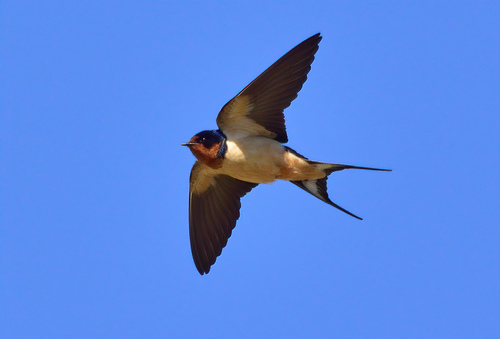
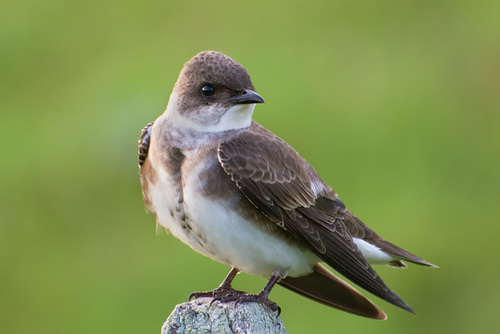
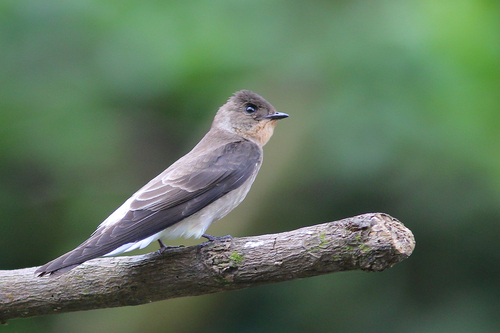
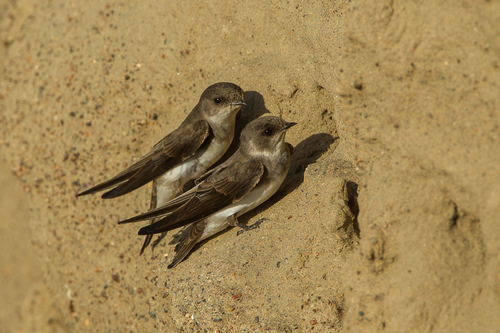
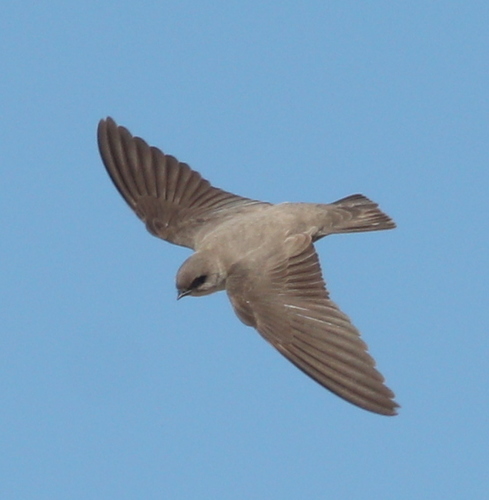
This species, Ptyonoprogne obsoleta, is commonly known as the pale crag martin. The nominate subspecies P. o. obsoleta measures 12–13 centimetres (4+1⁄2–5 inches) in length. It has light brown upperparts that grow paler on the lower back, and a short square tail with small white patches near the feather tips of all pairs except the central and outermost. Its throat, upper breast and underwing coverts are pale grey, and the remainder of its underparts are dirty white. It has brown eyes, a mainly black small bill, and brownish-pink legs. Average wing length is 13 cm (5 in), and average tail length is 4.8 cm (1+7⁄8 in). Males and females look similar, but juveniles have pale edges to their upperparts and flight feathers. Other subspecies differ from the nominate form in the details covered in the preceding table. This martin moults early; adults complete their full feather replacement by late August. Juveniles moult somewhat later, and retain their old primary feathers even once their body has mostly grown adult plumage. The pale crag martin has slow flight, with rapid wing beats mixed with flat-winged glides, and it is more acrobatic than the larger Eurasian crag martin. It is a quiet bird: its song is a muffled twitter, and other calls include a trrt similar to the common house martin's call, a nasal vick, and a high-pitched twee contact call. The pale crag martin is much drabber than most African swallows, and confusion is only likely with other crag martins or sand martins of the genus Riparia. Compared to the Eurasian crag martin, it is 15% smaller, paler and greyer, and has smaller tail spots. It is smaller, paler, and has a more contrasting throat than the rock martin. Across the far eastern part of its range, the pale crag martin always has lighter underparts than the dusky crag martin. Although it is only slightly larger than the sand martin and brown-throated sand martin, the pale crag martin is more robust, has white tail spots, and has no breast band. Separating similar species in flight can be made harder by the difficulty of judging colours correctly in strong desert light, especially for juvenile birds. The fast flight of the brown-throated sand martin also adds difficulty to identification. The pale crag martin breeds in suitable habitat across northern Africa, through the Middle East, and as far east as Afghanistan and Pakistan. It is mostly resident, only making local movements or moving down to lower altitudes after breeding. There is also some short-range movement: southern Arabian pale crag martins cross the Red Sea to winter alongside local breeding birds in Ethiopia and the Horn of Africa, and non-breeding P. f. spatzi and P. f. presaharica join rock martins in Mali and Mauritania. In Pakistan, the breeding range of subspecies P. f. peloplasta overlaps with that of the dusky crag martin, though the dusky crag martin breeds at much lower elevations. In North Africa, P. f. obsoleta lives in desert habitats, while the Eurasian crag martin occupies mountain areas. Pale crag martins have been recorded as vagrants in Bahrain, Qatar, Kuwait, and Sri Lanka, though a 2011 field guide considers its occurrence in Sri Lanka unproven. Claims that this species visits Turkey are also disputed. Its natural breeding habitat is hilly or mountainous terrain with cliffs, gorges and caves up to 3,700 m (12,100 ft) above sea level, but it also breeds in lowlands, especially when rocks or buildings are available, and may occur far from water. This species readily uses man-made structures in place of natural cliff sites; it has bred on houses in southern Israel since the 1970s. In Egypt it may breed near monuments like Abu Simbel or in desert towns such as Aswan. It uses towns, bridges and cliffs in Ethiopia, and tower blocks in Arabia. During the breeding season, the martin requires mud or wet soil to build its nests, which is normally easily found near human habitations. This species appears to be scarce in some humid forested and coastal areas, where the red-rumped swallow is typically the most common hirundine.