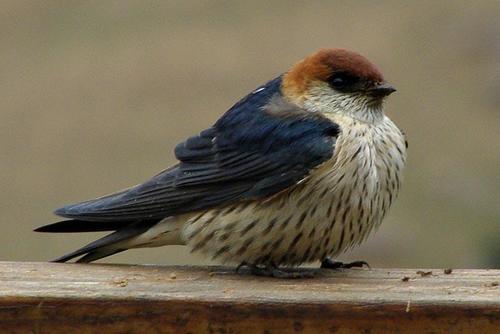
About Ptyonoprogne fuligula (Lichtenstein, 1842)
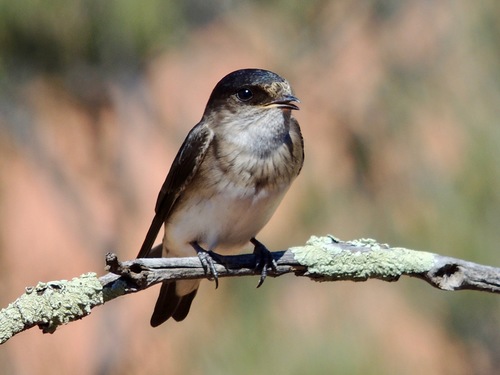
The nominate subspecies P. f. fuligula of Ptyonoprogne fuligula, the large rock martin, measures 12–15 cm (4.7–5.9 in) in length. It has earth-brown upperparts and a short square tail, with small white patches near the tips of all feather pairs except the central and outermost pairs. Its chin, throat, upper breast, and underwing coverts are cinnamon, while the rest of its underparts are a brown shade matching the upperparts. The eyes are brown, the small bill is mainly black, and the legs are brownish-pink. Males and females have similar appearance, but juveniles have pale edges along their upperparts and flight feathers. Other subspecies differ from the nominate form in ways detailed elsewhere. The large rock martin has slow flight: rapid wing beats are mixed with flat-winged glides, and it is more acrobatic than the larger Eurasian crag martin. It is a quiet bird. Its song is a muffled twitter, and its other calls include a 'trrt' that resembles the call of the common house martin, a nasal 'vick', and a high-pitched 'twee' contact call. The large rock martin is much drabber than most African swallows, and confusion is only likely with other crag martins or sand martins of the genus Riparia. The pale crag martin is smaller, paler, and greyer than this southern species. Although only slightly larger than the sand martin and brown-throated sand martin, the large rock martin is more robust, has white tail spots, and lacks a breast band. It is paler on the throat, breast, and underwings than the all-dark form of the brown-throated sand martin. The large rock martin breeds in suitable habitat across most of South Africa and Namibia. It has a more patchy distribution in Zimbabwe and is absent from most of Botswana. It is largely resident, only making local movements or descending to lower altitudes after breeding. Its natural breeding habitat is hilly or mountainous terrain with cliffs and escarpment ridges, often located far from water. When breeding, it readily uses man-made structures as a replacement for natural rock faces.