About Ptyonoprogne concolor (Sykes, 1832)
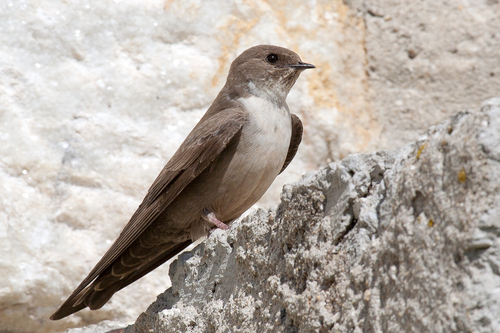
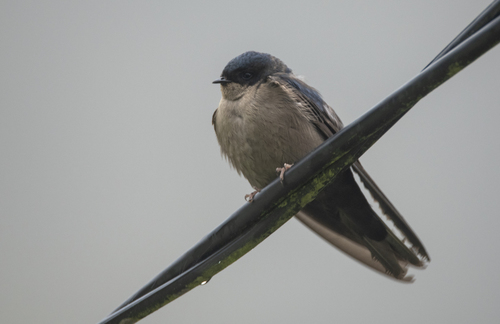
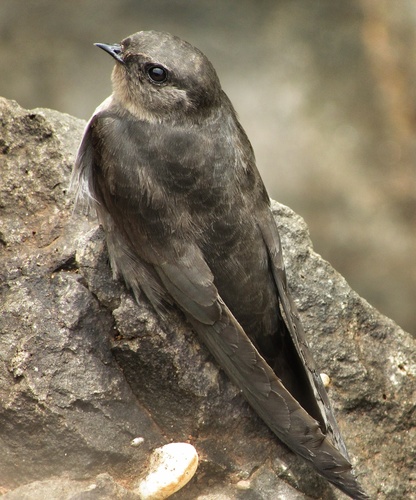
The dusky crag martin, Ptyonoprogne concolor (Sykes, 1832), measures 13 cm (5 in) in length, with a broad body, wings, and tail. Its upperparts are sooty-brown, while its underparts are slightly paler. The chin, throat, and foreneck are pale dull rufous with fine streaks. It has a short, square tail, with small white patches near the feather tips of all pairs except the central and outermost feather pairs. Its underwing coverts are dark brown, eyes are brown, the small bill is mainly black, and legs are brownish-pink. The sexes have identical plumage. Juveniles have rufous grey tips on the upperpart and wing plumage.
This species can be told apart from the Eurasian crag martin and rock martin by its darker underparts, and its white tail spots are noticeably smaller than those of the Eurasian crag martin. Its undertail coverts match the shade of the abdomen underside, while these coverts are darker in the Eurasian crag martin. This small martin typically flies slowly and leisurely, but is able to reach considerable speed when needed. Its calls are similar to those of the Eurasian crag martin, including a soft chi, chi contact call and a twittering song.
The nominate subspecies of the dusky crag martin breeds across most of the Indian subcontinent, ranging from the base of the Himalayas south to the Nilgiri mountains and east to West Bengal. The subspecies P. c. sintaungensis occurs in southwestern China, and northern Thailand, Vietnam, and Laos. The dusky crag martin is mostly resident, only making local movements after breeding. It has bred in Malaysia at least once, and has occurred as a vagrant in Sri Lanka, and probably Borneo. Its natural breeding habitat is hilly or mountainous terrain with cliffs, gorges, and caves, and it typically nests at altitudes up to around 1,800 m (5,900 ft), reaching up to 2,000 m (6,600 ft) in Thailand. It also breeds in lowland areas, using man-made structures as replacements for natural cliff faces. It particularly favours stone buildings such as old forts, and can be found in urban areas including Mumbai. Nests built on buildings can be up to 30 m (98 ft) above ground, and the species uses unusual nesting sites including light fittings.