About Ptychostomum pseudotriquetrum (Hedw.) J.R.Spence & H.P.Ramsay ex Holyoak & N.Pedersen
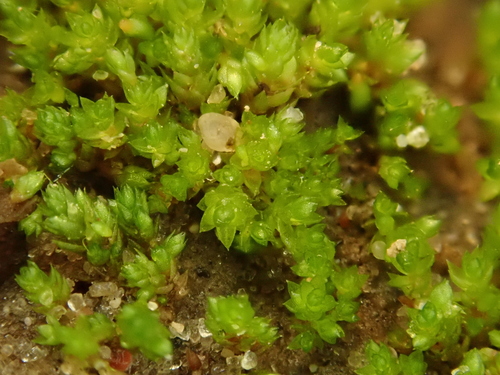
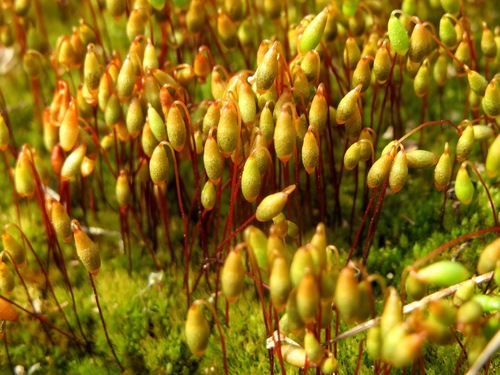
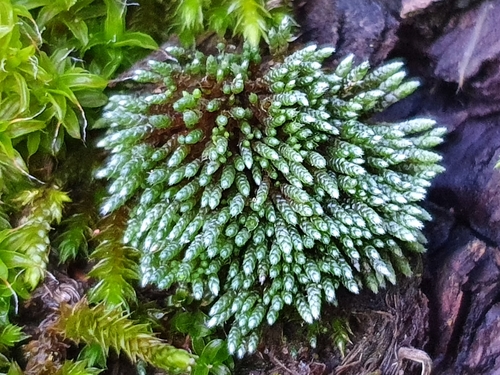
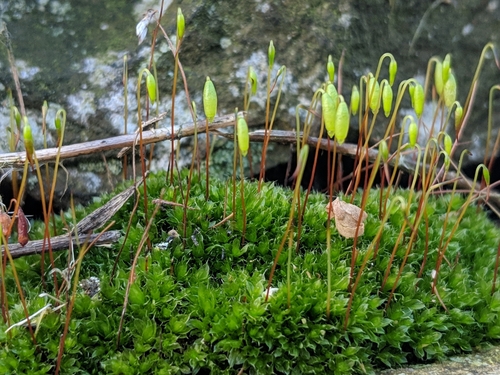
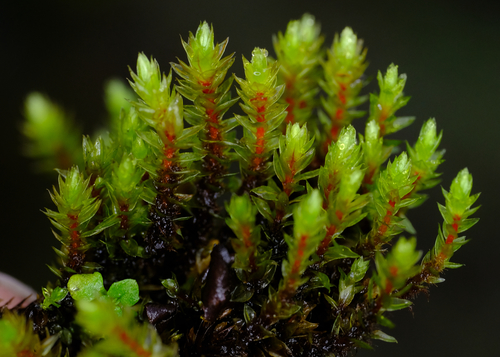
Ptychostomum pseudotriquetrum is a medium to large acrocarpous moss. Young specimens are yellow-green, turning red-brown as they age. Stems grow in dense turfs; they typically reach 2–4 cm in length, and can range from 1 cm to 6 cm. Stems may be weakly comose, meaning they are crowned with a tuft of soft leaves, or evenly covered in leaves. The lower stem is matted with papillose red-brown rhizoids, and stems branch sparingly via elongate, evenly foliate subfloral innovations. Leaves are typically 2–3 mm long, and can range from 1 mm to 4 mm in length. Young leaves are glossy, and colored green, red-green, or yellow-green. They turn dull brown-red or brick-red with age. When dry, leaves are twisted and contorted; when moist, they spread outward in an erect orientation, and are oblong-lanceolate to ovate-lanceolate, flat to weakly concave—this shape means leaves are widest near the base and taper to a point. Leaf cell walls are firm to thickened (incrassate), and sometimes porose. Basal leaf cells are rectangular and reddish. Distal leaf cells are rhomboidal-hexagonal to hexagonal, measuring 20–40 μm long and 12–20 μm wide. Leaves are bordered by 2–3 rows of narrow, thick-walled, usually red cells. Leaf margins are revolute (rolled downward) from the leaf base to at least the middle of the leaf, and are denticulate (bearing fine teeth) near the leaf apex. The stout red-brown costa (central leaf stalk) is percurrent to slightly excurrent, extending beyond the leaf apex and ending in a smooth awn. The leaf base is narrow and strongly decurrent, extending far down the stem. Some Northern Hemisphere populations reproduce asexually via brown gemmae located in leaf axils. This species is dioicous, meaning male and female sexual organs grow on separate individual plants. The seta (capsule stalk) is usually 1–3 cm long, and rarely reaches 4 cm; it is red when young, turning browner with age. The spore-containing capsule is 3–5 mm long, brown with a yellow mouth. It is thickened at its distal end, and has been described as elongate-ovate (elongated egg-shaped), cylindrical to clavate (club-shaped), or broadly pyriform (pear-shaped). Capsules are either pendulous or inclined. The diplolepidous peristome that rings the capsule mouth has two sets of teeth: an inner endostome and an outer exostome. Exostome teeth are orange-brown, yellow-brown, or pale yellow, and are papillose at the tip. Endostome teeth are yellowish and translucent (hyaline), lightly papillose, marked with broad perforations, and supported by a basal membrane that reaches half the height of the exostome teeth. Two to three long, threadlike, appendiculate cilia attach to the endostome cells. The operculum (capsule cap) is 0.5–0.8 mm long, conic-apiculate, and ends in a sharp point. Spores are pale yellow or green, 12–18 μm in diameter, and finely papillose. In the Northern Hemisphere, capsules mature between April and October; they mature in summer or fall overall. This species has a bipolar distribution, and is also found in temperate regions of the Southern Hemisphere. It occurs on all continents including Antarctica, but is largely absent from the tropics, subtropics, and islands of the central Pacific Ocean. It grows on rocks and wet soil alongside streams and lakes, as well as in fens, wet heaths, and marshes, at elevations from 0 to 4000 m.