About Ptychocheilus grandis (Ayres, 1854)
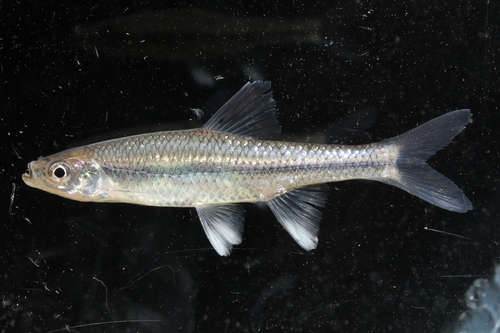
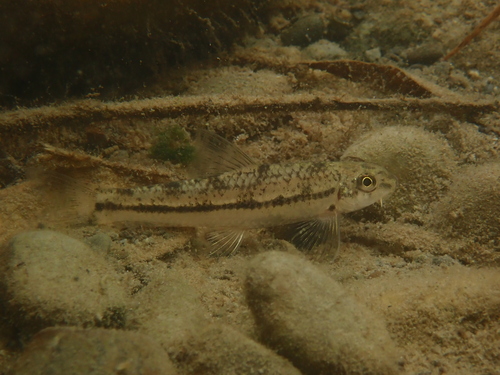
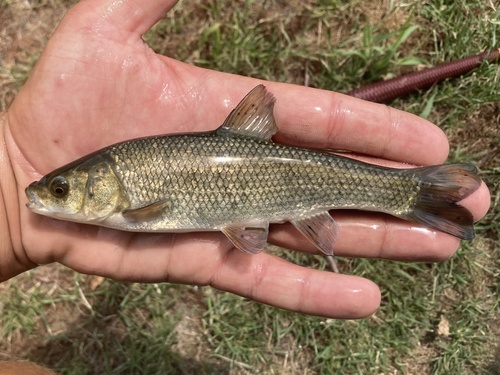
Ptychocheilus grandis (Ayres, 1854), commonly called the Sacramento pikeminnow, has an elongated, slender body, a flattened head, and a large mouth adapted for catching prey. It has a narrow caudal peduncle and a deeply forked tail. The outdated former common name referencing 'squawfishes' is now considered offensive. Larger adult individuals are dark brown to olive in color, with a golden-yellow underside. Smaller specimens are silver and have a distinct dark spot at the base of the tail. Fish that are spawning develop orange-reddish coloration on their tails, and males typically develop nodes or tubercles on their heads. This species has 8 dorsal rays, 8 anal rays, 15–18 pectoral rays, and 9 pelvic fin rays. The maximum recorded weight for the species is approximately 14.6 kg (32 lb), though the official certified weight record is only 5.19 kg (11 lb 7 oz). There are usually 67–75 scales along its lateral line, and around 12–15 scales above the lateral line. It is closely related to three other pikeminnow species in the same genus: the Colorado pikeminnow (Ptychocheilus lucius), Northern pikeminnow (Ptychocheilus oregonensis), and Umpqua pikeminnow (Ptychocheilus umpquae). The four species can be distinguished by their regional distribution, maximum weight, and small differences in appearance such as scale and fin ray counts. The Sacramento pikeminnow is a common, widely distributed species native to California. Its natural native distribution includes low and middle elevation reaches of the Sacramento-San Joaquin Province, the Clear Lake Basin, and the Pajaro-Salinas and Russian river systems. It has also been introduced to the Eel River, tributaries of Morro Bay, and reservoirs in Southern California. It is uncommon in the freshwater Delta region. Introductions of this species occurred when juveniles were released when used as bait fish, or when they were accidentally included with stocked game fish. These warmwater fish can live up to 16 years. They reach sexual maturity at 3–4 years of age, after which they spawn annually. A single female can lay 15,000 to 40,000 eggs per year, meaning a single female can produce up to half a million eggs over her lifetime. After hatching, larvae disperse via water flow and quickly move to find suitable habitat in backwaters. Juveniles that migrate to the delta grow faster than juveniles in tributary habitats, particularly during spring and early summer. The species spawns in non-tidal rivers, and migrates upstream from deltas to reach spawning sites, though this behavior varies widely: some individuals travel long distances to spawn, while others stay in their original location. They prefer to lay eggs in riffles and pool tails with gravel substrates. In the warm spring months of April and May, males swim upstream to find suitable spawning habitat. One to six males will pursue a single female. When females deposit eggs close to the riverbed, males swimming close behind the female fertilize the eggs at the same time.