About Ptyas korros (Schlegel, 1837)
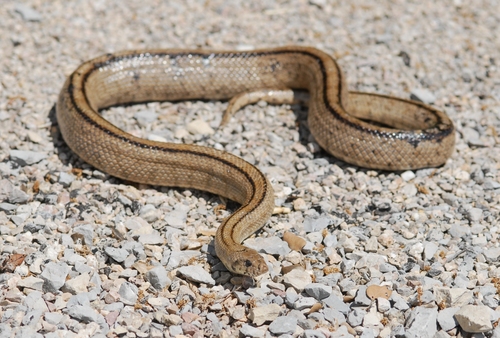
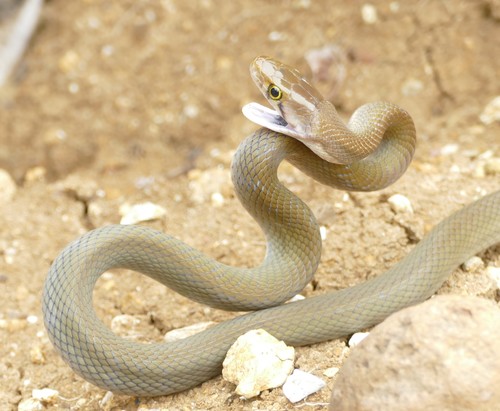
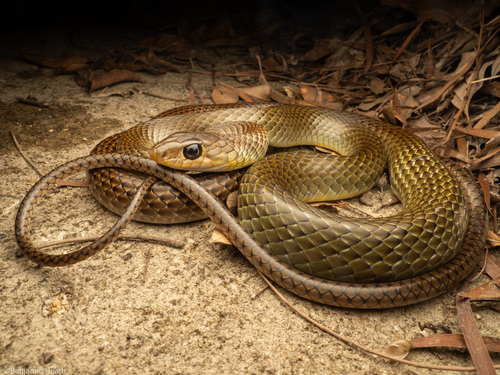
This species, Ptyas korros (Schlegel, 1837), has the following morphological characteristics. Its snout is obtuse and projecting, its eye is very large, and its head is broader than the neck. The rostral scale is visible from above; internasals are shorter than the prefrontals; the frontal scale is as long as its distance from the tip of the snout, or a little longer, and matches the length of the parietals. There are two or three loreal scales, one large preocular scale that sometimes touches the frontal, one small subocular scale below the preocular, and two postocular scales. Temporal scales follow a 2 + 2 arrangement. There are eight upper labial scales, with the fourth and fifth entering the eye orbit; five lower labial scales contact the anterior chin-shields, which are shorter than the posterior chin-shields. Dorsal scales are smooth or feebly keeled on the posterior portion of the body, arranged in 15 rows at midbody. There are 160–177 ventral scales, the anal scale is divided, and there are 122–145 subcaudal scales. The dorsal side is brown or olive; scales on the posterior body and tail are often yellow and edged with black. The ventral surface is yellow. Young individuals have transverse series of round whitish spots, or narrow yellow transverse bars. The combined length of the head and body reaches 1,080 mm (43 in), and the tail reaches 700 mm (28 in). This species is distributed across Nepal, Myanmar, Cambodia, China (Zhejiang, Jiangxi, Fujian, Guangdong, Hainan, Guangxi, Hunan, Yunnan, Hong Kong), Taiwan, India (Assam; Manipur; Arunachal Pradesh, including Namdapha in Changlang district, Chessa, Chimpu, and Itanagar in Papum Pare district), Tripura, Bangladesh, Indonesia (Sumatra, Borneo, Java, Bali), Laos, Thailand, Vietnam, West Malaysia, and Singapore Island. It can be found at elevations up to 3000 m above sea level.