About Ptisana salicina (Sm.) Murdock
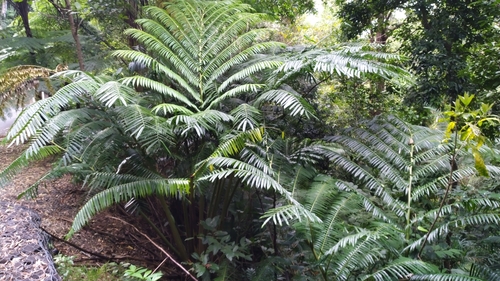
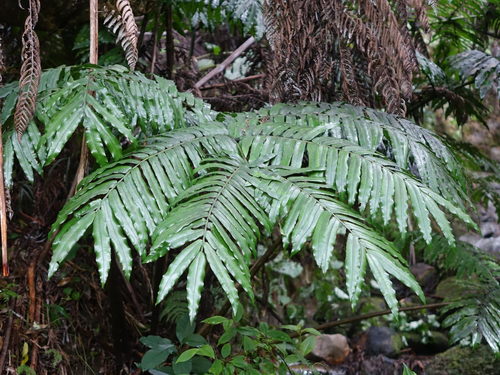
Ptisana salicina (Sm.) Murdock has green, cane-like leaf stalks that grow 1 to 3 metres long. As young fronds uncoil, they are protected by a large, ear-shaped basal lobe at the frond base called a stipule. Its glossy, dark green mature fronds reach 4 metres in length, sometimes up to 5 metres, and 2 metres wide. Juvenile fronds are less robust and wilt quickly when exposed to sunlight. In the Kawhia region, a distinct form of this species is occasionally found, where adult leaflets have crested tips. Mature, appropriately aged specimens can produce spores at any time of year. This species is indigenous to Norfolk Island (its type locality), New Zealand, New Caledonia, the Cook Islands, the Austral Islands, the Society Islands, and the Marquesas. It is closely related to Ptisana smithii, which occurs in Vanuatu, Fiji, the Solomon Islands, Samoa, and Tonga. In New Zealand, Ptisana salicina grows in lowland areas of the north-western half of the North Island, ranging from inland Wanganui northwards. It is most abundant in western Waikato, where it grows in forests and surviving forest remnants. It prefers soils rich in limestone, including cave entrances and shady stream banks. In New Zealand, it often grows alongside parataniwha (Elatostema rugosum) and supplejack (Ripogonum scandens).