About Ptilotus helipteroides (F.Muell.) F.Muell.
Ptilotus helipteroides is an erect to ascending annual herb that usually reaches a maximum height of 60 cm (24 in). Its stems and leaves are covered with a medium to dense layer of simple hairs. The leaves are sessile, with shapes ranging from linear and elliptic to lance-shaped, and sometimes have the narrower end oriented toward the base. Most leaves are 5–70 mm (0.20–2.76 in) long and 2–10 mm (0.079–0.394 in) wide.
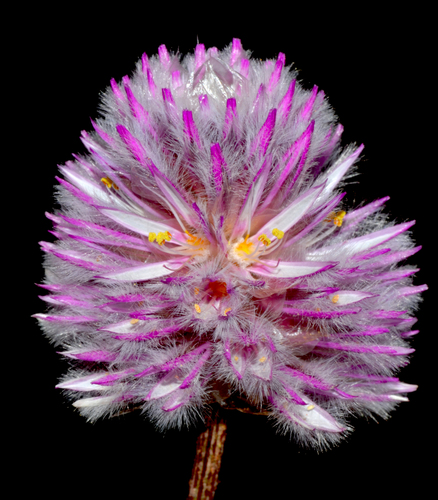
Flowers of this species are arranged in oval, cylindrical or hemispherical spikes that grow up to 30 mm (1.2 in) long and 14–21 mm (0.55–0.83 in) wide. The spikes have colourless, hairless bracts 6.8–7.2 mm (0.27–0.28 in) long, and similarly shaped bracteoles 3.8–5 mm (0.15–0.20 in) long. The outer tepals measure 8.2–9.2 mm (0.32–0.36 in) long, while the inner tepals measure 7.5–8.7 mm (0.30–0.34 in) long. This species has 4 stamens and 1 staminode. The style is 3.0–3.6 mm (0.12–0.14 in) long, curved, and attached to the side of the ovary. Flowering takes place between April and October.
Ptilotus helipteroides grows in red stony sand and sandy loam. It is widespread across arid Australia, with a range extending from the west coast of Western Australia, through southern Northern Territory and northern South Australia, to Boulia in western Queensland.