About Ptilotus gaudichaudii (Steud.) J.M.Black
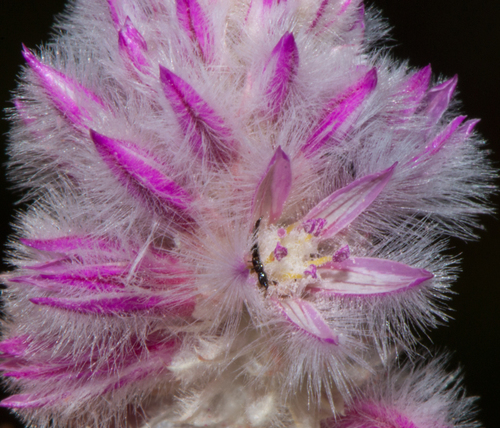
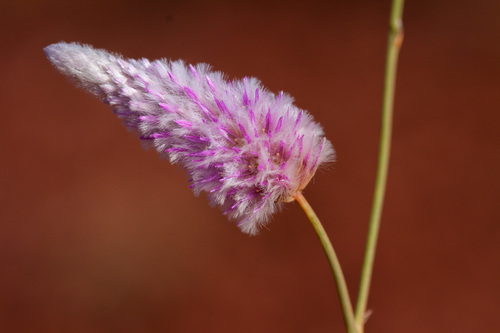
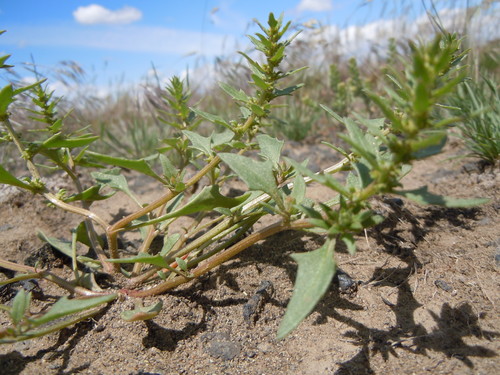
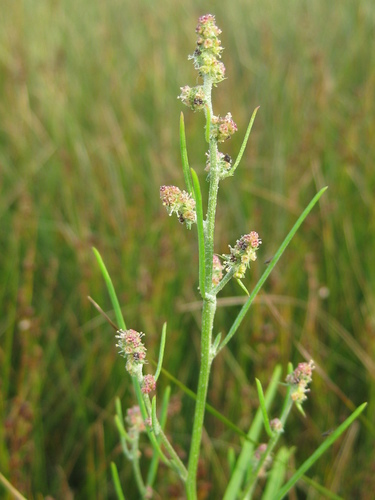
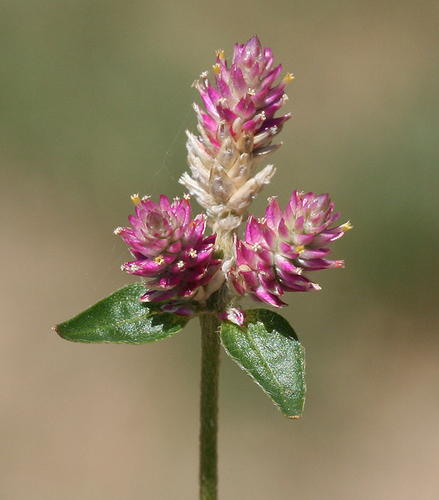
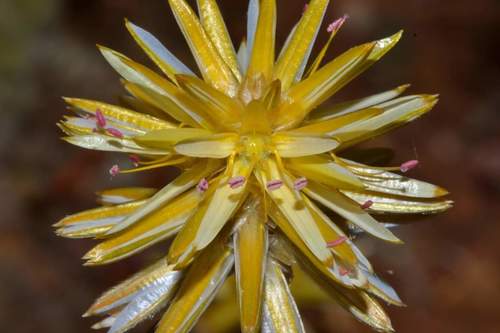
Ptilotus gaudichaudii is an erect or ascending annual herb that typically grows up to 50 centimeters (20 inches) tall. Its stems and leaves have a sparse covering of simple hairs. Leaves of this species are either sessile or borne on a short petiole, and range in shape from linear to elliptic or lance-shaped. Most leaves are 15–62 millimeters (0.59–2.44 inches) long and 1–6 millimeters (0.039–0.236 inches) wide. Flowers are arranged in short spherical to oval spikes that are 10–50 millimeters (0.39–1.97 inches) long and up to 20 millimeters (0.79 inches) wide. The spikes have egg-shaped to circular colourless bracts that are mostly 3–5 millimeters (0.12–0.20 inches) long, and 3.5–6 millimeter (0.14–0.24 inch) long bracteoles with a prominent midrib. The outer tepals measure 11–14 millimeters (0.43–0.55 inches) long, while the inner tepals measure 10.7–13.5 millimeters (0.42–0.53 inches) long. This plant has 3 stamens and 2 staminodes, with a straight style 8–10 millimeters (0.31–0.39 inches) long that attaches to the side of the ovary. Flowering occurs from April to October. It grows on sand, loam or clay, and is widespread across Western Australia, South Australia, the Northern Territory and Queensland, with scattered populations in the far west of New South Wales.