About Ptilotus exaltatus Nees
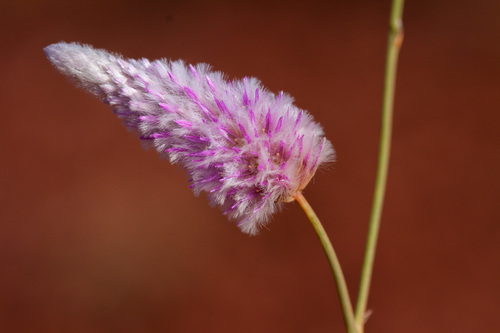
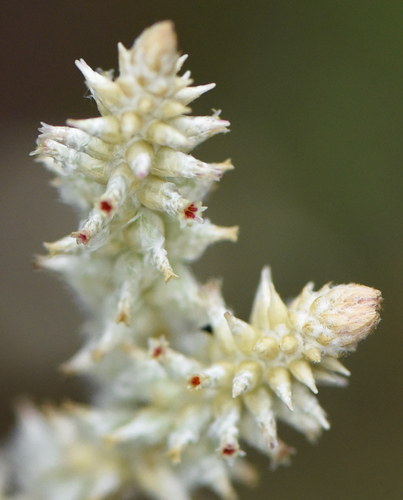
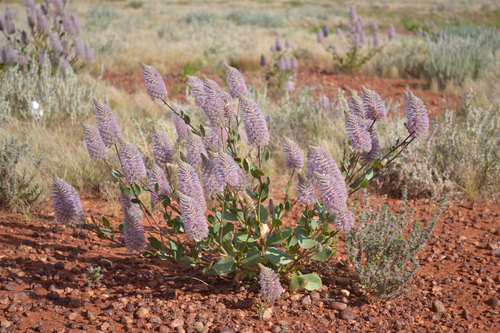
Ptilotus exaltatus Nees, commonly known as pink mulla mulla, is an annual or short-lived perennial herb that usually grows up to about 1 metre (3 feet 3 inches) tall, and has a fleshy taproot. Its stems may be covered in shaggy hairs, or almost hairless. Basal leaves are linear, lance-shaped, or spatula-shaped, measuring 50–200 mm (2.0–7.9 in) long and 20–60 mm (0.79–2.36 in) wide, and sometimes bear dense whorled hairs. Stem leaves are narrowly elliptic to egg-shaped with the narrower end toward the base, 1–115 mm (0.039–4.528 in) long and 30–40 mm (1.2–1.6 in) wide. Stem leaves are sometimes wavy, and end in a small, fragile point 1–3 mm (0.039–0.118 in) long. Its flowers are pink to purple, and arranged in cylindrical spikes that are 20–200 mm (0.79–7.87 in) long and 30–50 mm (1.2–2.0 in) wide. Egg-shaped bracts 5–10.5 mm (0.20–0.41 in) long and bracteoles 7.5–10.5 mm (0.30–0.41 in) long sit at the base of each spike. Tepals are pink to purple, spread widely as flowers develop, and have whorled hairs on their outer surface. The species has either 2 or 3 stamens with pink anthers, and 2 or 3 staminodes. Flowering occurs in most months, with a peak between October and January. This species is found across all Australian states and the Northern Territory. It is widespread everywhere except the far south of Western Australia, all but the far north of the Northern Territory, and occurs in western New South Wales, north-western Victoria's mallee communities, northern South Australia, and western Queensland. It grows in a wide range of habitats including grasslands, eucalypt woodlands, and acacia shrublands, and is commonly found on red sands, brown sands, red sandy clays, calcareous loams, and stony or gravelly soils. It grows best in full sunlight, with 6–8 hours of sunlight per day for ideal growth, and is drought tolerant, requiring only minimal watering. Ptilotus exaltatus is a highly desirable Australian native for horticulture, valued for its abundant, colourful flowers, but its horticultural use is limited by poor natural germination rates. The plant's seed dispersal unit is a 2 mm × 1.5 mm (0.079 in × 0.059 in) nut enclosed by the perianth, which prevents germination. Removing the perianth sheath surrounding the seed triggers a 60–80% increase in germination. Germination rate is not affected by temperature or light, and two main barriers to germination have been identified for uncleaned seeds: the surrounding perianth tissue and the testa both prevent germination in most cases. Removing these layers surrounding the seed leads to a significant increase in germination. Both slow-release fertiliser and liquid nitrogen-based fertiliser promote plant growth and earlier flowering. A key challenge for successful commercial cultivation of pink mulla mulla is achieving rapid growth and flower development while controlling stem height to keep plants compact. Research shows that substantial applications of different nitrogen and superphosphate-based fertilisers can deliver satisfactory growth control to enable wider horticultural production. Ptilotus exaltatus is classified as a phosphorus hyperaccumulator, because it can survive in high-phosphorus soils without developing phosphorus toxicity. It tolerates very high soil phosphorus levels without any reduction in leaf and shoot dry weight, a key indicator of plant health. It does this by preferentially storing phosphorus in mesophyll cells to form calcium crystals, and balancing increased cellular phosphorus by raising potassium levels and reducing sulphur levels. The main use of this species is as a garden plant. Its vibrant colours and strong stems create a pleasing aesthetic, and its adaptation to most Australian conditions makes it a suitable choice for gardens across the country. Overseas horticultural industries also have interest in Ptilotus exaltatus. Experiments growing the species under Central European conditions found an 85% germination success rate for cleaned seeds in these conditions. Year-round growth tests show that while P. exaltatus can grow successfully year-round in Australia's arid and semi-arid conditions, under Central European conditions it only produces healthy, usable flowers from late April or early May through to late September or early October, because Northern Hemisphere winter conditions are too cold for successful flowering. Pink mulla mulla attracts bees and butterflies, which improves overall garden health when planted in home gardens. Growing demand for Australian native plants worldwide has led to increasing cultivation of Ptilotus exaltatus in Western Australia to produce cut flowers for export. Experiments testing the effects of different amounts of nitrogen, phosphorus, and potassium on growth found that the highest volume of applied nitrogen produced the maximum shoot dry weight.