About Ptilotus drummondii (Moq.) F.Muell.
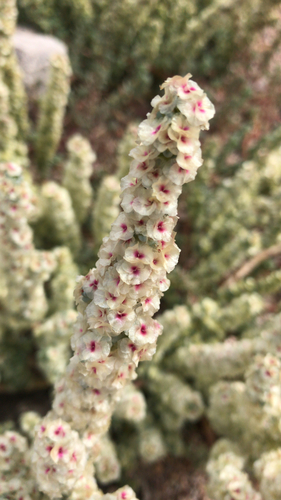
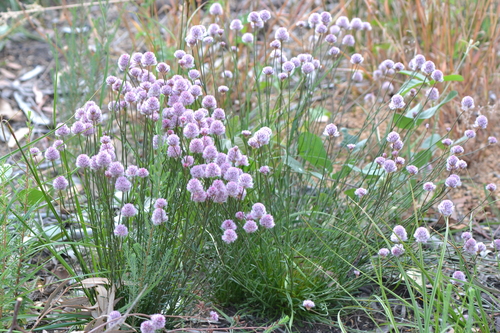
Ptilotus drummondii (Moq.) F.Muell. is a perennial herb. It usually reaches a height of 0.5 to 80 cm (0.20 to 31.50 in), and produces several stems that are sometimes more or less prostrate. Both its basal leaves and stem leaves are linear, measuring 8 to 35 mm (0.31 to 1.38 in) long and 1 to 4 mm (0.039 to 0.157 in) wide. The flowers are arranged in dense oval or spherical clusters; the flowers themselves are pink when they open, and rapidly fade to yellowish-white. The bracts at the base of each flower head are mostly 4.6 to 5.5 mm (0.18 to 0.22 in) long, while the bracteoles are 4 to 5 mm (0.16 to 0.20 in) long. The outer tepals are 8.0 to 9.6 mm (0.31 to 0.38 in) long, and the inner tepals are 7.6 to 9.1 mm (0.30 to 0.36 in) long, with a tuft of hairs on their inner surface. The style is 2.0 to 2.7 mm (0.079 to 0.106 in) long. It flowers from March to May, and again from July to December. This species grows in a variety of soil types on low ridges, undulating plains, and near rivers. It is widely distributed across the Avon Wheatbelt, Carnarvon, Central Ranges, Coolgardie, Esperance Plains, Gascoyne, Geraldton Sandplains, Gibson Desert, Great Sandy Desert, Great Victoria Desert, Jarrah Forest, Little Sandy Desert, Mallee, Murchison, Nullarbor, Pilbara, Swan Coastal Plain, Warren, and Yalgoo bioregions of Western Australia.