About Ptilotula penicillata (Gould, 1837)
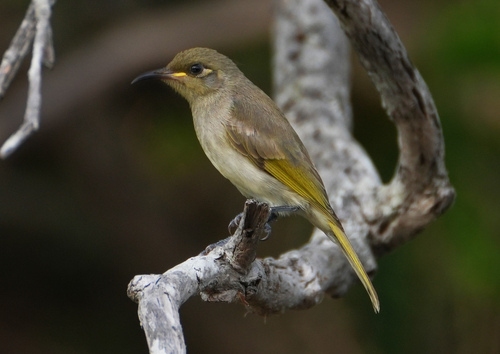
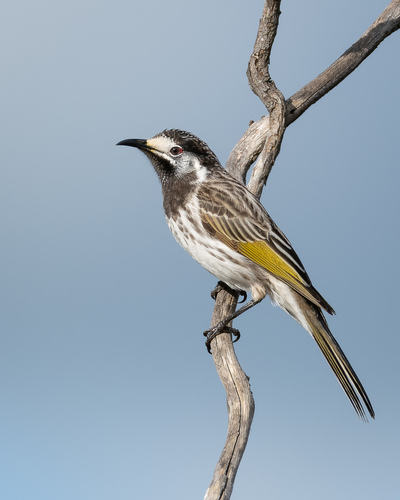
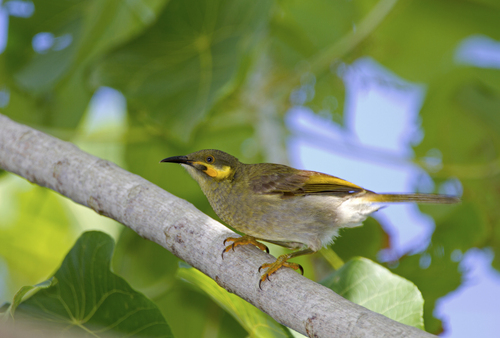
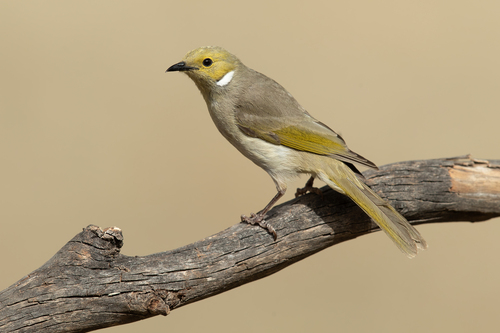
Males and females of Ptilotula penicillata do not differ in plumage. The species’ key identifying feature is a prominent white plume extending across the neck from the throat to the edge of the nape. The top of the head and neck are olive, with a yellow eye-ring surrounding a black-brown to olive-brown eye. Cheeks and ear coverts are yellow-olive, and rear ear coverts are tipped black; this forms a short black stripe along the front edge of the neck plume. The chin and throat are dull yellowish-olive. The upperparts are uniform grey-olive, and the uppertail coverts have a faint yellowish tinge. Upperwing coverts are mostly brown, with olive to yellow-olive tips or edges that create a slightly scalloped look. Remiges are dark brown, with yellowish edges along the secondaries that form a yellow-olive panel when the wing is folded. The uppertail is olive-brown, with yellow-olive outer edges. The underbody is mostly light brown-grey, with pale yellow streaks down the center of the breast, pale yellow markings on the upper belly, flanks and undertail coverts, and cream coloring on the lower belly. Underwing coverts are off-white, with brown-grey remiges. The undertail is brownish grey, and the feet and legs are pinkish to purplish grey. The bill and gape are black during the breeding season. Outside of breeding, the base of the bill becomes orange-yellow or orange-brown — this change only affects the lower mandible in some individuals — and the gape becomes yellow. Four subspecies of Ptilotula penicillata are recognized: Ptilotula penicillata penicillata, P. p. leilavalensis, P. p. carteri and P. p. calconi. Compared to the nominate subspecies, P. p. leilavalensis is paler and yellower, P. p. carteri has a strong yellow tinge, and P. p. calconi is yellower. These subspecies interbreed and intergrade where their ranges overlap. Across all four subspecies, males are slightly larger than females. The nominate P. p. penicillata is the largest subspecies, with males averaging 20.5 g (0.72 oz) and females averaging 18.1 g (0.64 oz). P. p. leilavalensis and P. p. carteri are similar in size: males average around 18 g (0.63 oz) and females average around 16 g (0.56 oz). P. p. calconi is the smallest, with males averaging around 17.5 g (0.62 oz) and females averaging around 16 g (0.56 oz). Wing lengths are notably larger in P. p. penicillata, while bill lengths differ only slightly between subspecies; the bill of P. p. carteri is somewhat longer than the bills of the other three subspecies. Juvenile Ptilotula penicillata resemble adults, but have duller coloring on the top of the head and neck, and brighter coloring on the eye-ring and ear coverts. The neck plume of juveniles is shorter and less distinct, and often lacks the black border formed by the tipped ear coverts. Juvenile underbodies are slightly browner than adult underbodies. The bill of young individuals is pink or yellowish with a brown tip, and it darkens to black with a yellow-orange or pinkish base as the bird matures. The gape of juveniles is yellow and noticeably puffy. In newly fledged birds, the feet and legs are paler pinkish-brown than adults, and appear swollen compared to adult feet and legs. Ptilotula penicillata is widely distributed across mainland south-eastern Australia — it is not found in Tasmania — and extends north into central Australia, with patchy populations in central and western Queensland, the Northern Territory, and Western Australia. It is absent from true desert areas, but can survive in arid regions that have trees and especially standing water. The nominate subspecies P. p. penicillata ranges across south-eastern Australia as far west as Spencer Gulf in South Australia, and across the entire Murray-Darling basin. P. p. leilavalensis occurs from Lake Eyre south to the Flinders Ranges in South Australia, east to the Barrier Ranges in western New South Wales, west to the edges of the Gibson and Great Sandy Deserts, and north to central-western Queensland. P. p. carteri is found in Western Australia’s Pilbara region, from Geraldton to the Fortescue Ranges, and east into the Western Deserts. P. p. calconi is only known from the southern Kimberley region. The species has expanded its range over the last century. Historically, its distribution was tightly linked to river red gum (Eucalyptus camaldulensis) and a small number of other riverine tree species. It has since spread into coastal areas, and is now a permanent resident in Sydney and Newcastle, where it was previously uncommon or only found as a seasonal visitor. Banding studies show the species is primarily sedentary: 99.8% of recaptured banded individuals were found less than 10 km (6.21 miles) from their original banding site. The species does make small local movements, likely in response to changing environmental conditions. Ptilotula penicillata is an oligotypic species that occurs mainly in open sclerophyll woodland, often close to water sources such as wetlands, swamps, creeks, and dams. It is abundant in river red gum woodlands, and also lives in riparian woodlands dominated by Eucalyptus, Melaleuca or Casuarina species. It can also be found on nearby river flats, and in adjacent open forest and woodland.