About Ptilotula ornata (Gould, 1838)
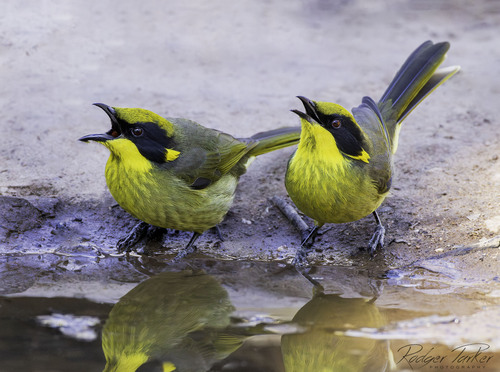
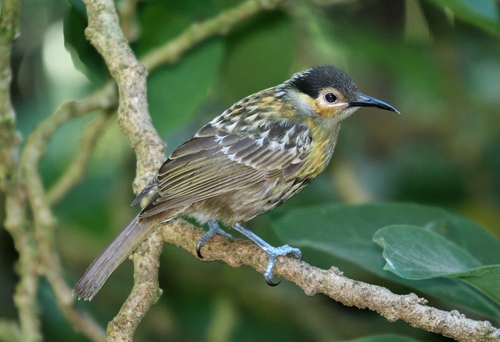
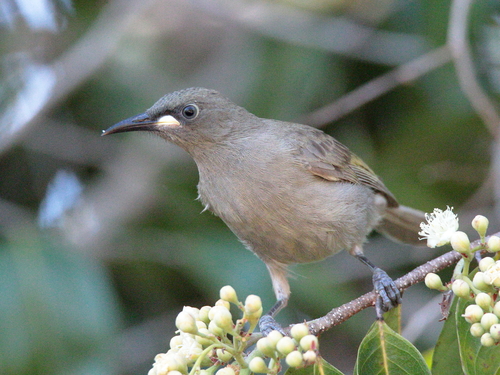
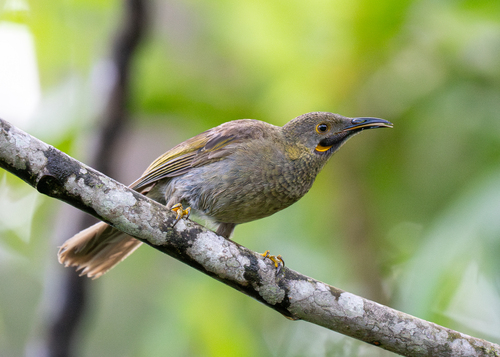
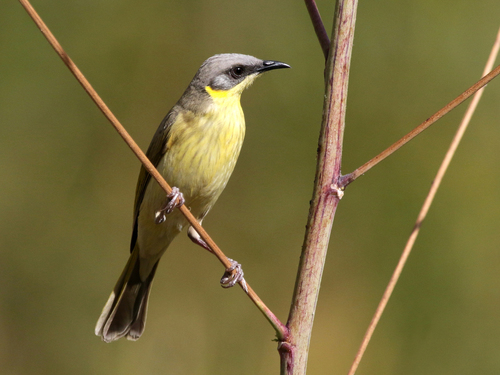
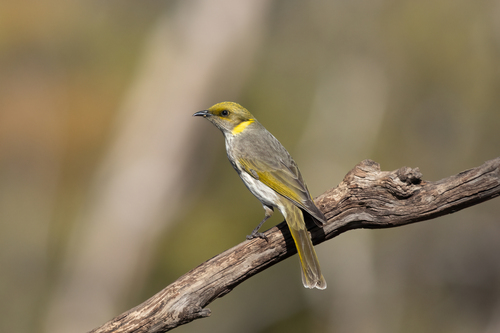
The yellow-plumed honeyeater, scientific name Ptilotula ornata (Gould, 1838), is a medium-sized honeyeater. It has a relatively long, down-curved black bill, a dark face, and a distinctive upswept yellow neck plume. Its head is olive-green, with a faint yellow line running under the dark eye. It has grey-green upperparts and heavily streaked grey-brown underparts. Juvenile yellow-plumed honeyeaters have a yellow bill base and a yellow eye-ring. Species similar to the yellow-plumed honeyeater include the purple-gaped honeyeater, grey-fronted honeyeater, and fuscous honeyeater.
This species is endemic to southern mainland Australia. Its range extends from western New South Wales and Victoria, through South Australia, to south-west Western Australia.
The main habitat of the yellow-plumed honeyeater is mallee. In the western part of its range, it occupies a broader set of habitats, including dry eucalypt woodland and open eucalypt forest. It occasionally occurs outside its usual habitat, such as in Acacia and Callitris woodland, and seasonally in flowering red ironbark forest, as well as flowering grey box-yellow box woodland.
Yellow-plumed honeyeaters live in sedentary colonial groups. These groups may relocate to avoid harsh conditions. They are noisy and conspicuous, and jointly defend nesting or feeding territories through communal wing quivering displays.
For reproduction, yellow-plumed honeyeaters build an open cup-shaped nest. The nest is suspended by its rim from foliage or a thin fork of mallee eucalypts and other small shrubs. Nests are constructed from wool, green grass, and spider webs, and lined with wool, grasses, plant down, and brightly coloured feathers. Both parents feed the young, sometimes with assistance from helpers. Yellow-plumed honeyeater nests are regularly parasitised by fan-tailed cuckoos, pallid cuckoos, Horsfield's bronze-cuckoos, and shining bronze-cuckoos.