About Ptilotula keartlandi (North, 1895)
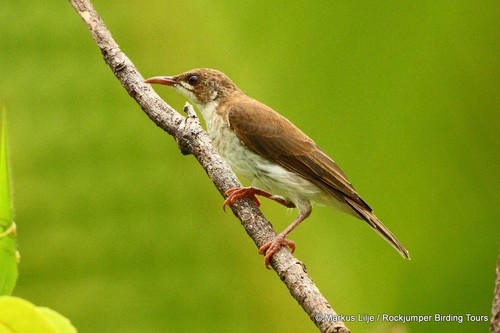
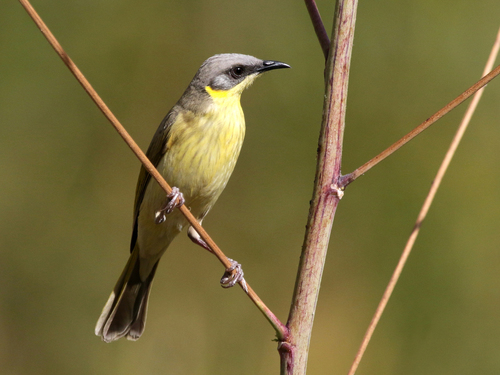
Ptilotula keartlandi, commonly known as the grey-headed honeyeater, is a relatively small honeyeater species. Adults measure 13–16.5 cm (5.1–6.5 in) in total body length and weigh 12–18 g (0.4–0.6 oz). Individual wing length ranges 67–81 mm (2.6–3.2 in), tail length ranges 55–69 mm (2.2–2.7 in), and bill length ranges 14.5–18.5 mm (0.6–0.7 in). Males are slightly heavier and larger than females, though there is no difference in plumage between the sexes, and no geographical plumage variation across the species' range. Adults have a distinctive grey crown above a black facial mask, with the nape and rest of the upper body colored dark fawn-grey. The black facial mask stretches from the base of the bill to the back of the ear coverts, and includes black lores, eye rings, feathers behind the eye, and grey-black ear coverts. The base of the mask is bordered by a thin, bright yellow plume that extends below and behind the ear coverts, plus a pale yellow moustachial stripe between the lores and throat. The bill is black, short, and slightly down-curved, with a yellow base on the lower mandible that may turn fully black during breeding. The iris is black to dark brown, and the gape is yellow, which also turns black during breeding. The throat, breast, belly, and flanks are light olive-yellow streaked with brown, while the rump is light grey-brown. Flight feathers are olive-brown edged with olive-yellow, which creates a yellow panel on the wing when it is folded. Tail feathers are dark olive-brown, also edged with olive-yellow. This species has ten primary flight feathers, ten secondary flight feathers, and twelve tail feathers. Juveniles have similar plumage to adults but are generally paler, with a lighter grey-brown face mask, a lighter grey crown, and a grey-black bill with an orange-brown base, and they retain yellow gapes. Soon after fledging, juveniles partially moult into immature plumage, which is similar to adult plumage, but the juvenile tail and flight feathers are retained. Immature individuals can be identified by fault bars present on the tail. Full moult into adult plumage happens during the bird's first year. The grey-headed honeyeater makes a continuous, peevish chip call when feeding, and produces a wee-wee-wee song. Other vocalizations include a loud, single kwoyt and chee-toyt, which may only be given during breeding. The grey-headed honeyeater has an extensive range across much of central arid and semi-arid Australia, with an estimated extent of occurrence of 4,360,000 square kilometres (1,680,000 sq mi). It most commonly lives in Eucalyptus scrub and woodlands on stony hill country and timbered gullies within mountain ranges, but can also be found on sandplains when local vegetation is in flower. The species has also been recorded in mulga and mallee woodlands, riverine areas dominated by river red gum (Eucalyptus camaldulensis), and occasionally in Mitchell grasslands. The grey-headed honeyeater is considered largely sedentary, but will make nomadic movements to follow flowering events. These movements are mostly local, though some longer movements have been recorded: one individual was observed at East Point, Darwin, 270 kilometres (170 mi) north of its previously documented range, after major Eucalyptus flowering events.