About Ptilothrix bombiformis (Cresson, 1879)
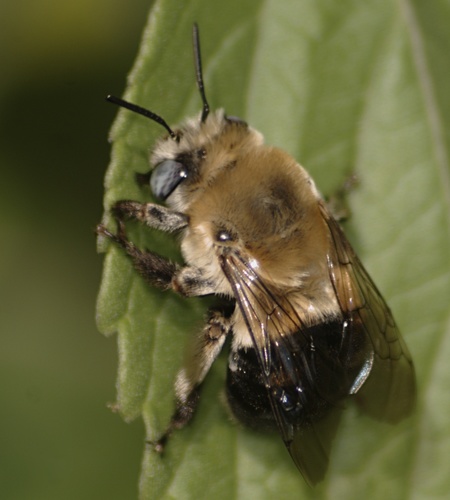
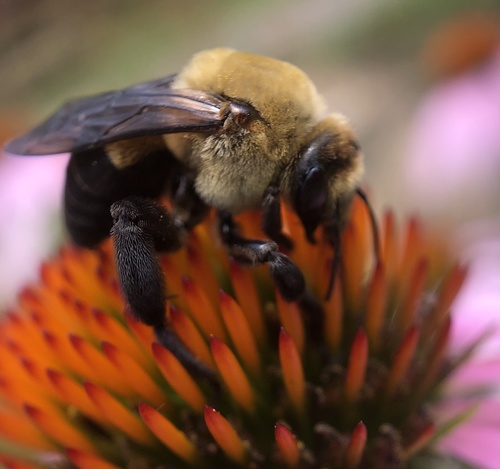
Ptilothrix bombiformis, commonly called the hibiscus bee, has a large, rounded body shape similar to a bumblebee. This shape is the reason for its species epithet bombiformis, which means bumblebee-shaped. The bee has yellow hairs covering its head, mesosoma, and the first segment of its metasoma, while all remaining segments of the metasoma are black. Both male and female hibiscus bees have very long, hairy legs, but female hind legs are noticeably hairier. These extra hairs on the female are plumose branched hairs that are used to carry pollen and water back to the nest. The hibiscus bee has three core requirements for its habitat: the presence of Hibiscus flowers, access to water, and an area of hard-packed, dried mud soil for nesting. These requirements are most commonly met in marshy areas that support the growth of Hibiscus plants, also known as mallows. However, this adaptable species also lives in human-altered landscapes. It can gather pollen from landscaping hibiscus plants, use dirt roads and levees as nesting sites, and access water from puddles formed by sprinkler systems. The hibiscus bee is a specialist that feeds exclusively on Hibiscus pollen, and its emergence as an adult lines up with the annual hibiscus bloom period. Along with native Hibiscus species that grow within its range, such as Hibiscus moscheutos and Hibiscus laevis, it will also collect pollen from the introduced species Hibiscus syriacus, commonly called rose-of-Sharon. In eastern Texas, the hibiscus bee is a key pollinator of the endangered Hibiscus dasycalyx. A 2025 study of this plant found that while its flowers are visited by generalist pollinators including beetles and skippers, the hibiscus bee visits far more frequently, and only visits from the hibiscus bee result in successful pollination. As a hibiscus bee larva feeds, it excretes feces that consist largely of pollen exines, which are the hard outer shells of pollen grains, along the inner wall of its nesting cell. After feeding for a few weeks, the larva spins a cocoon to stay in through the winter. After completing metamorphosis, adult bees emerge the following summer. This species is univoltine, meaning it produces only one generation per year with no overlapping generations, as adult hibiscus bees do not survive through the winter.