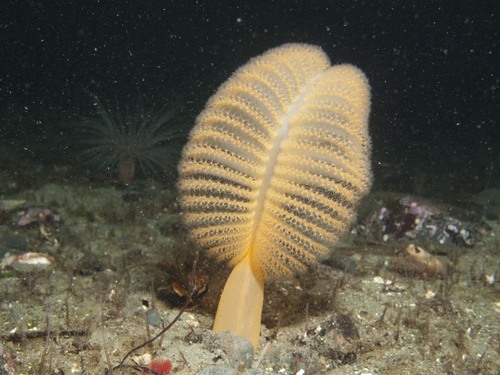
About Ptilosarcus gurneyi (Gray, 1860)
Ptilosarcus gurneyi, commonly called the orange sea pen, is a colonial cnidarian where individual polyps carry out specialized functions. A single primary polyp loses its tentacles, and forms both the colony stalk called the rachis and the bulbous base that anchors the entire colony deep into soft substrate. All other polyps are secondary polyps, divided into two distinct types. The first type, autozooids, act as feeding polyps. They have eight branching tentacles armed with cnidocytes that make up the sea pen's feathery branches, and they also contain the colony's gonads. The second type of secondary polyp, siphonozooids, move water in and out of the colony to ventilate it. When the colony is disturbed, it can pump water out of its body and retract into its bulbous base. During this response, it emits bioluminescence, which may startle potential predators. This species gets its common name from its resemblance to an old-fashioned quill pen. It grows to about 46 centimetres (18 inches) in height, and individuals can be white, yellow, or orange. The orange sea pen occurs along the western coast of North America, with a range that stretches from Alaska to southern California. It inhabits soft sand or mud substrates at depths between 14 and 225 metres (46 to 738 feet).

