About Ptiloris paradiseus Swainson, 1825
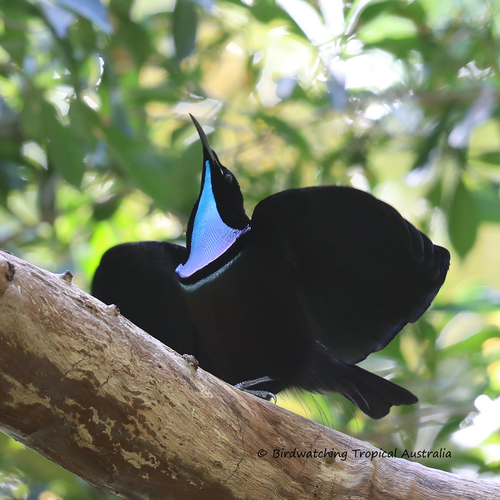
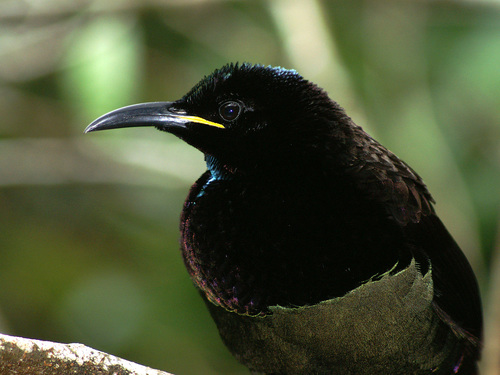
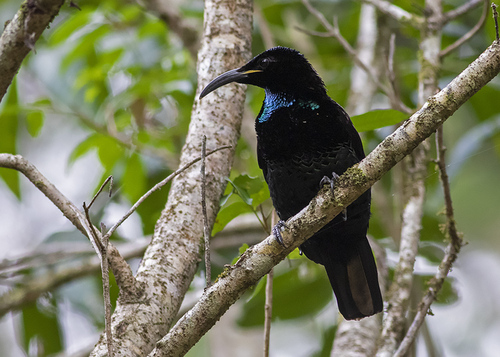
The paradise riflebird (Ptiloris paradiseus Swainson, 1825) is a medium-sized bird with distinct sexual dimorphism. Males average around 30 cm (11.8 in) in length and weigh 134 to 155 g (4.7 to 5.5 oz) on average, while females are slightly smaller, averaging 29 cm (11.4 in) in length and 86 to 112 g (3.0 to 3.9 oz) in weight on average. Both sexes share a long, black decurved bill, black legs, and dark brown irises, and have almost no overlapping plumage traits due to their sexual dimorphism. Adult males are primarily black, with iridescent greenish-blue coloring on the crown, throat, and central tail feathers, and iridescent green coloring on the lower breast and flank. The central tail feathers are shortened, creating an appearance of blue over black along the tail. Some of the male's feathers are thought to be specialized super black feathers. Unlike typical black feathers, the barbules of these modified feathers structurally absorb light, creating a more intense dark appearance. These super black feathers are located next to brightly colored feather patches, and researchers suggest they create optical illusions during courtship displays by exaggerating the brightness of the adjacent colored patches. Adult females have gray-brown plumage, with rufous coloring on the primary and secondary wing feathers. Females also have a white supercilial streak, a white throat, and lighter brown plumage with dark barring across the breast, flanks, and belly. Compared to males, adult females have a noticeably longer, more decurved bill. Very little is recorded about the appearance of juvenile paradise riflebirds; juveniles of both sexes resemble adult females and have gray-brown feathers. Like the Victoria's riflebird and the growling riflebird, the paradise riflebird has a growling vocalization. Males are known for their powerful "yaassss" call, which is typically repeated one at a time and lasts approximately 2 seconds. The paradise riflebird is endemic to eastern Australia, occurring from New South Wales to Queensland, where it lives in rainforest habitats. It resides in the rainforest canopy at elevations above 500 m (1,640 ft), though individuals move to lower elevations (sometimes below 200 m / 656 ft) during winter. It is primarily a sedentary species with a low population density, but it does make local migrations, moving from wet rainforests to nearby sclerophyll forests. The paradise riflebird feeds mainly on insects and fruit while foraging high in the forest canopy. Occasionally, 6 to 7 individuals will gather into foraging aggregations; outside of these events, the species is solitary, dispersed, and non-territorial. Breeding takes place from August to February, which corresponds to spring and summer in Australia. Like other birds of paradise, the paradise riflebird is promiscuous and polygynous. Males perform solitary courtship displays for females from perches on low, exposed canopy branches. Though the species is generally non-territorial, males are thought to defend these display perches territorially during the mating season. The courtship display consists of rapid side-to-side movements of the horizontally held wings (similar to other riflebirds) and the head, along with gaping the mouth to expose the iridescent blue-green sheen on the throat. As noted earlier, it is hypothesized that the male's super black feathers create an optical illusion during courtship that emphasizes the brightness of the adjacent iridescent patches. Female paradise riflebirds raise offspring entirely on their own. Nests of the paradise riflebird are similar in shape to Victoria's riflebird nests, but are larger and bulkier. The average clutch size for the species is 2 eggs.