About Ptilonorhynchus violaceus (Vieillot, 1816)
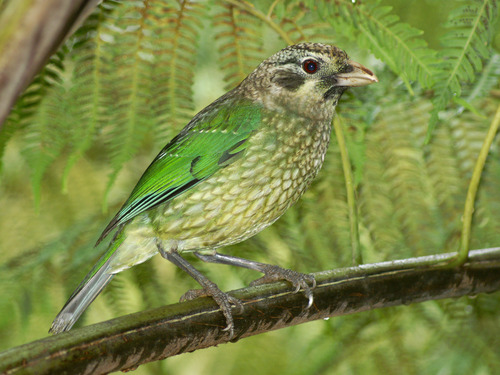
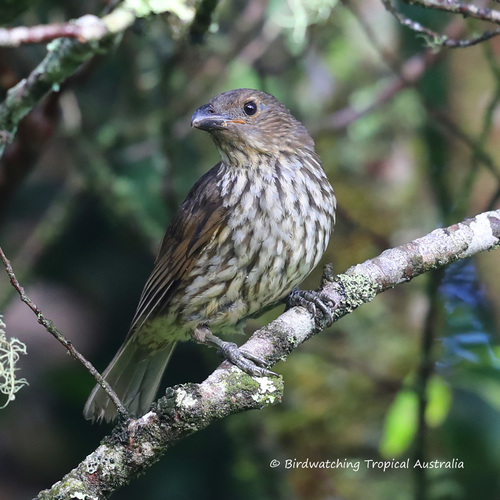
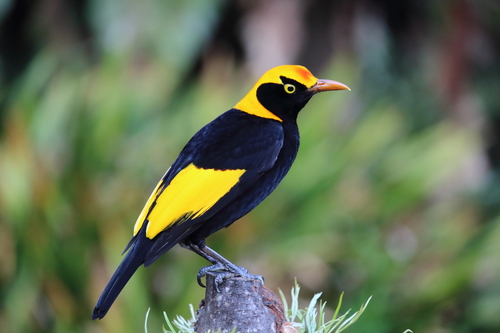
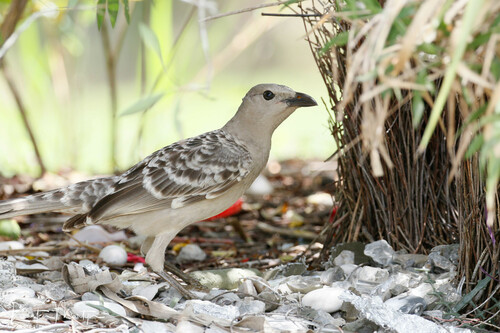
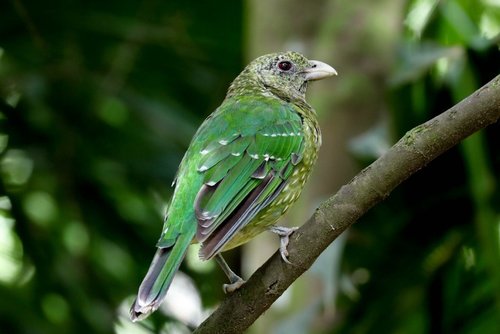
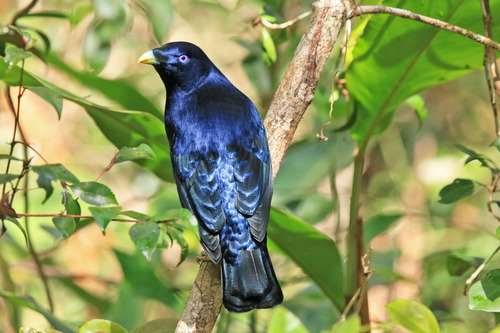
Mature male satin bowerbirds have violet-blue eyes and solid black feathers. However, light diffraction from the surface texture of their feathers produces an almost metallic sheen, which creates a deep shiny blue appearance. Immature males have the same colour and patterning as females, and are often mistaken for females. Females can be confused with green catbirds or spotted catbirds. They have distinctly green-brown or entirely brown upper bodies, lighter under bodies with a clear reticulated or scalloped pattern, and very striking blue eyes. The satin bowerbird is common in rainforest and tall moist sclerophyll forest in eastern Australia, ranging from southern Queensland to Victoria. It also has an isolated population in the Wet Tropics of north Queensland. Satin bowerbirds nest between October and February. Typically, females lay two eggs, though they may occasionally lay one or three. Eggs are placed in a shallow twig nest topped with leaves from Eucalyptus or Acacia trees. These leaves turn brown as eggs are laid, and may provide camouflage. The eggs are cream-coloured with brown streaks. At around 19 grams (0.67 oz), the eggs are much larger than is typical for a bird of this species' size. Eggs are laid every other day, and hatch asynchronously after 21 days of incubation. Young satin bowerbirds are able to fly three weeks after hatching, but stay dependent on the female for an additional two months. They finally disperse at the beginning of the southern winter, in May or June. Female satin bowerbirds reach maturity at two to three years old. Males do not reach maturity until they are seven or eight years old, when they have finished moulting into their characteristic blue-black adult plumage. The satin bowerbird is the longest-lived passerine bird for which there is high-quality banding data. It is estimated that the average lifespan of the species is around eight or nine years. The record for the longest lifespan of a banded passerine in the wild is held by this species, at twenty-six years.