About Ptilogonys cinereus Swainson, 1827
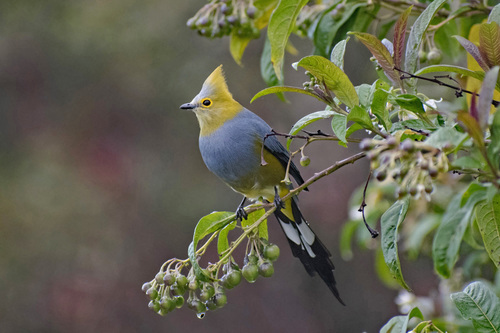
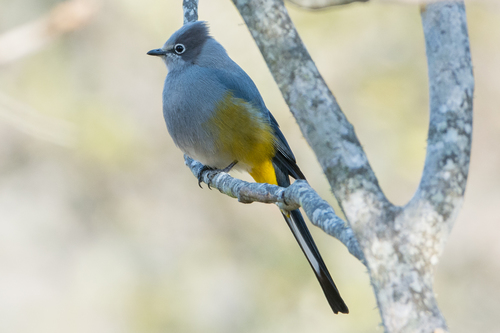
The grey silky-flycatcher (Ptilogonys cinereus Swainson, 1827) measures 18.5 to 21 cm (7.3 to 8.3 in) in length. It is a slender bird with a prominent crest and a long tail. For adult males of the nominate subspecies P. c. cinereus, the head and crest are mostly blue-gray, with dusky lores, a white patch above the lores, a thin white eye-ring, and white or brownish-white chin and cheeks. Their upperparts are blue-gray, their flight feathers are black. The central pair of their tail feathers is black; all other tail feathers have a black base, a white upper half, and a black lower half. Their throat and breast are gray, their belly is whitish, their flanks are golden-olive or yellow, and their undertail coverts are bright yellow. Adult females have a gray head and crest with a white eye-ring, grayish-brown upperparts, brown sides and flanks, and a white belly. Both sexes have a dark iris, a black bill, and black legs and feet. Juveniles resemble adult females but have paler underparts. Males of subspecies P. c. molybdophanes have deeper bluish-gray upperparts than the nominate subspecies and olive-green flanks. Females of this subspecies are overall darker than nominate females, but share the nominate's bright yellow undertail coverts. Males of P. c. otofuscus have upperpart coloring that falls between that of the nominate and P. c. molybdophanes. They have darker ear coverts, and the whitish area of their belly is more extensive than that of the nominate. Females of this subspecies have a grayer back, lighter rump and uppertail coverts, and a darker breast than nominate females. Males of P. c. pallescens are paler and grayer than the nominate, with grayer ear coverts, and a grayish white (rather than brownish white) loral spot, chin, and throat. Females are paler and less brown than nominate females, with more contrast between the gray crown and throat and the back and breast. The subspecies of the grey silky-flycatcher have the following distribution ranges. P. c. cinereus ranges from southern Coahuila, southern Nuevo León, and Jalisco south to southern and western Michoacán and Oaxaca in central and eastern Mexico. P. c. otofuscus occurs in southern Sonora, southwestern Chihuahua, eastern Sinaloa, western Durango, and western Zacatecas in northwestern Mexico. P. c. pallescens is found in eastern Michoacán and Guerrero in southwestern Mexico. P. c. molybdophanes ranges from Chiapas in southern Mexico south into south-central Guatemala. The species has also been recorded as a vagrant in southern and western Texas. The grey silky-flycatcher inhabits pine, pine-oak, and juniper forest in the subtropical and temperate zones. It also occurs in pine savanna, and is rarely found in cloudforest. Sources disagree on the species' overall elevational range: one source states it occurs between 1,100 and 3,200 m (3,600 to 10,500 ft), while another records it mostly between 1,000 and 3,500 m (3,300 to 11,500 ft), at lower elevations during winter. In Guatemala, it is found between 1,200 and 3,050 m (3,900 to 10,000 ft), and occurs mostly above 1,700 m (5,600 ft).