About Ptilogonys caudatus Cabanis, 1861
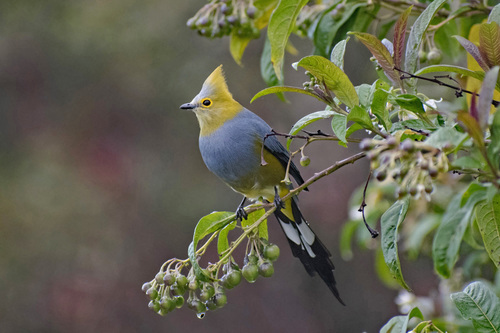
Ptilogonys caudatus Cabanis, 1861, commonly called the long-tailed silky-flycatcher, measures 20 to 24.4 cm (7.9 to 9.6 in) long and weighs approximately 37 g (1.3 oz). It is a slender bird with a prominent crest and a long tail, where the central pair of tail feathers extends beyond all other tail feathers. Adult males have a gray forehead and crown, plus a thin yellow eye-ring. The rest of the male's face, crest, and neck are yellowish olive-green. The male's back, rump, uppertail coverts, and upperwing coverts are bluish gray. Their flight feathers and tail are black, with most tail feathers bearing a large white patch in their middle section. The male's throat is grayish olive-green, while their breast and upper belly are a slightly paler olive-green than their back. Their lower belly, sides, and flanks are yellowish olive-green, and their undertail coverts are bright yellow. Adult females are overall duller in color than males, and have a somewhat shorter tail. The female's head, neck, and crest are a paler yellowish olive-green than the same regions on males. Their back, rump, uppertail coverts, upperwing coverts, breast, and upper belly are olivaceous gray. Females have a yellowish white lower belly, greenish yellow flanks, and yellow undertail coverts. Both sexes have a dark iris, a black bill, and black legs and feet. Juveniles are generally light grayish brown overall. They have a whitish eye-ring, brownish uppertail coverts, paler underparts than adult birds, pale yellow undertail coverts, and brownish bill and feet. The long-tailed silky-flycatcher is distributed across two mountain ranges: the Cordillera Central in central Costa Rica, and the Cordillera de Talamanca which runs from south-central Costa Rica into western Panama. The two populations are separated by deep river valleys where the species does not occur. It inhabits somewhat open landscapes in the subtropical and temperate zones, including primary forest edges, secondary forest, pastures with scattered trees, and gardens. Multiple sources disagree on the species' elevational range: two sources report a range of 1,800 to 3,000 m (5,900 to 9,800 ft), while a third source lists a range from 1,600 m (5,200 ft) to timberline.