About Ptilodon capucina (Linnaeus, 1758)
The coxcomb prominent, with the scientific name Ptilodon capucina (Linnaeus, 1758), is a moth belonging to the family Notodontidae. It is a common species found across the entire Palearctic realm, ranging from Ireland to Japan. This species was first formally described by Carl Linnaeus in the 10th edition of Systema Naturae, published in 1758.
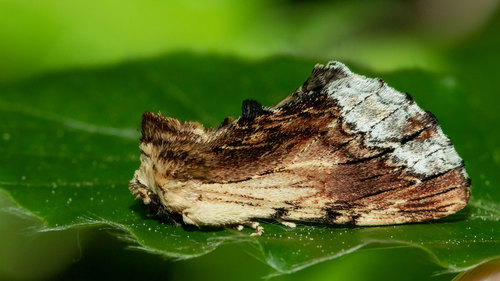
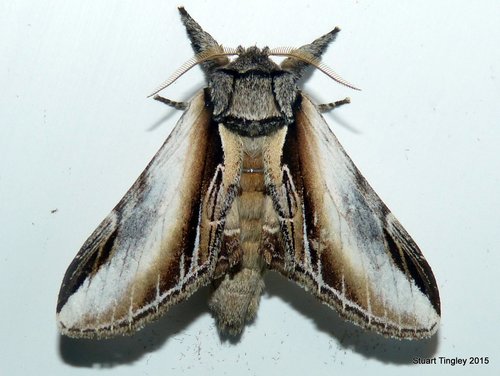
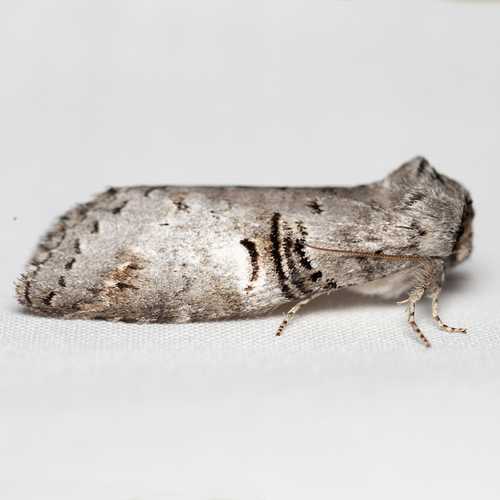
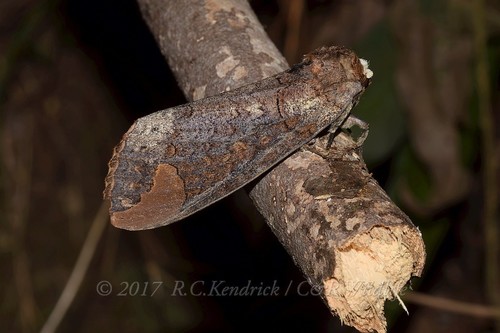
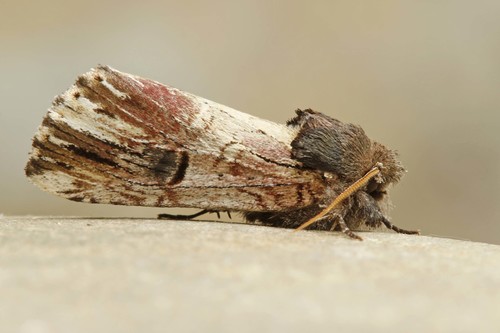
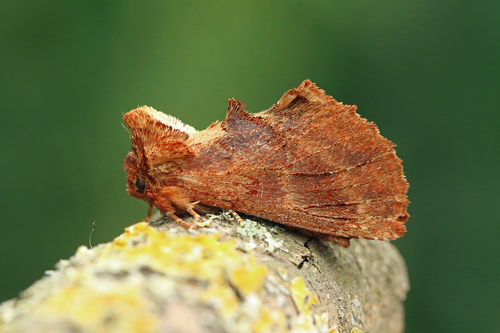
Ptilodon capucina has brown forewings that vary greatly in shade, with unclear darker markings. Its hindwings are buff-toned, and have a black spot at the tornus. When at rest, the species has a highly distinctive profile: tufts of hair protrude upward from the thorax and the hind edge of the forewings. This tufted feature on the hind edge of the forewings is shared with other prominent moth species. The forewing margins are also wavy. This somewhat lumpy overall appearance led to the common name comparison to the comb on a rooster's head.
A description from Seitz notes: The thorax and forewing are reddish grey, with a ground tone that can be lighter or darker. The two transverse bands are narrow, black, very sharply dentate, and strongly close together at the tooth of scales on the hind margin. Beyond the postdiscal band lies a whitish submarginal band, which is often only faintly visible. The hindwing is paler, coloured yellowish brown or greyish brown. It has a black anal spot crossed by a transverse whitish line, and a faintly marked pale postdiscal band. This moth is distributed from Northern Spain and Central Italy across all of Europe, northward to Scotland and Scandinavia, and eastward across Siberia to Korea and Japan.
The aberration giraffina Hbn. is a dark form, with forewing ground colour ranging from red-brown to blackish. It occurs across the entire distribution range of Ptilodon capucina; it is rare in the western part of the range, but more common in Japan.
The egg of this species is distinctly globose and whitish. Young larvae are green, with a glossy black head and numerous deep black dots that each bear long hairs. Fully fed larvae range from greenish to pale brown-red. They have two dark red pointed tubercles on the 8th abdominal segment. The stigmata are black, with a red spot behind each. Larvae are found from May to September on a variety of deciduous trees, most commonly birch and lime, and stay grouped together when young. When at rest, the larva holds its head raised in a sphinx-like shape.
The pupa is dark red-brown, with a pointed anal end that bears several thin spines. It develops inside a cell in the ground at the base of trees. In the southern part of its range, the moth produces two broods per year, flying from April to May and again from July to August. Northward from central Germany, there is only one brood per year, active from April to June. It is one of the most common prominent moth species. For a detailed list of recorded food plants, see Robinson et al., 2010.