About Ptilinopus magnificus (Temminck, 1821)
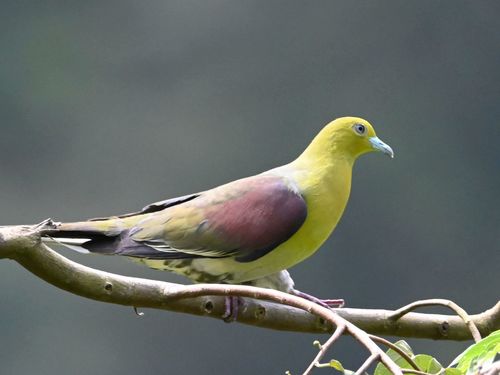
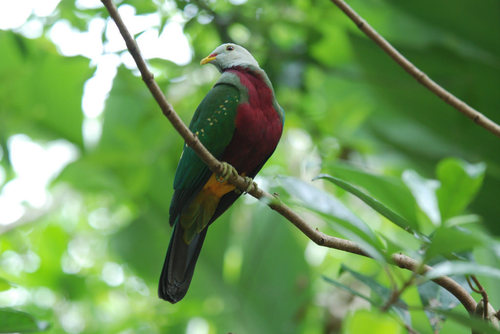
The wompoo fruit dove (Ptilinopus magnificus) can reach a total length of up to 45 cm (18 in), though individuals from northern regions are typically much smaller. It has purple feathers covering its neck, chest, and upper belly; its lower belly is yellow, and it has green underparts. Males and females have similar appearance, while juveniles have duller, greener plumage than adult birds. Despite their bright coloration, their unobtrusive, quiet habits make them difficult to spot in the forest canopy. Their distinctive call, which sounds like wollack-wa-hoo, is often described as very human-like. Where food is plentiful, wompoo fruit doves may gather in large flocks. They feed in rainforests on fruit from trees and vines, and they occasionally also eat insects. They are able to consume large fruits whole, and can collect fruit acrobatically from tree and vine structures. They do not travel long distances, instead preferring to remain in local areas and feed on whatever fruit is in season. The diet of this species was extensively studied in the Port Moresby area by Frith et al. (1976). Despite their relatively small size, they can swallow fruits with a volume of 5 cm³ (0.31 cu in), which equals a diameter of roughly 2 cm (0.79 in) for a spherical fruit. Major food items used by the birds include: figs, particularly Ficus macrophylla, as well as Ficus albipila, Ficus benjamina, Ficus drupacea, Ficus glaberrima, Ficus virens, and Ficus wassa. Figs are preferentially eaten during the late dry and wet season, which runs from October to March. Fruit from cinnamon trees (Cinnamomum sp.), Litsea, Neolitsea, and Cryptocarya are eaten whenever these fruits are available. Fruit from Arecaceae (palms), including genera Archontophoenix, Arenga, Calamus, and Caryota, are eaten from mid-late dry season (August to October) and in January. Fruit from Annonaceae, such as Ylang-ylang (Cananga odorata) and Polyalthia, are eaten whenever available. Minor food items are: fruit from Eugenia, Syzygium, and Acmena, which are most important in May; fruit from Hypserpa, which are most important in July and August; fruit from Planchonella, which are most important from August to October; fruit from Elaeocarpus, which are most important in October; fruit from Erythroxylon scarinatum, which are most important in November and December; and fruit from Tinospora smilacina, Glochidion, Gomphandra australiana, Gomphandra montana, Cayratia, Cissus, Terminalia, Diospyros, Chionanthus, Vitex cofassus, Alocasia, and Psychotria, which are taken when available.