About Ptilinopus jambu (J.F.Gmelin, 1789)
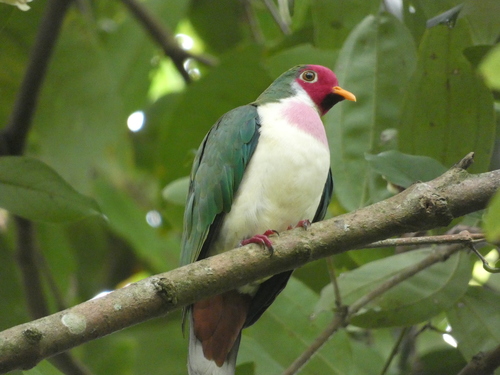
Ptilinopus jambu (J.F.Gmelin, 1789), commonly known as the jambu fruit dove, measures 23–27 cm (9.1–10.6 in) in length and weighs approximately 42 g (1.5 oz). This species is a plump, small-headed dove with soft feathers and very distinctive coloring. Both males and females share a white eye ring, an orange bill, and red legs. Adult males have a crimson face with a black chin, unmarked dark green upperparts, and ivory white underparts, with an added pink breast patch and a chocolate brown undertail. Females differ from males by having a dull purple face with a dark chin; their underparts are dull green with a white belly and cinnamon or buff colored undertail. Immature jambu fruit doves resemble females, but have a green face. Young males gain their full adult plumage approximately 39 weeks after fledging, and immature males share the same appearance as females. The species produces a soft, low cooing call. The jambu fruit dove ranges from the Malay Peninsula through Sumatra (including the Riau Archipelago, and the islands of Nias, Bangka, and Belitung) to Borneo, and may also be present in west Java. It inhabits mangrove swamps, lowland rain forests up to 1,500 m (4,900 ft), and secondary woodland. This is a shy, inconspicuous bird, whose green plumage provides camouflage against the forest canopy. It is most often seen alone or in pairs, but large flocks may gather to feed at fruiting trees. It eats fruit directly from trees, or will eat fruit that has fallen to the ground after being dropped by hornbills or monkeys. Like other doves, and unlike most other bird species, the jambu fruit dove can drink by sucking.