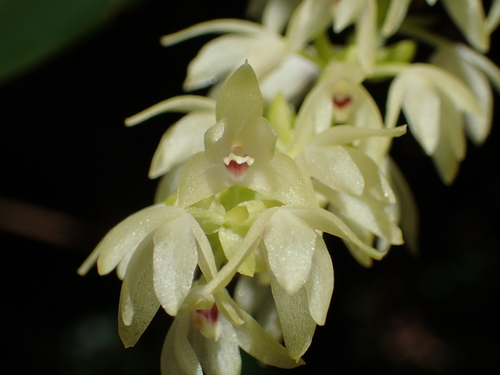
About Pterostylis truncata Fitzg.
Pterostylis truncata Fitzg. has distinct growth forms when not flowering versus when flowering. When it is not flowering, it forms a rosette of between two and six bright green leaves. These leaves range from egg-shaped to lance-shaped, and each measures 10–35 mm long and 5–18 mm wide. When flowering, this species produces a single white flower marked with green and brown stripes, carried on a flowering spike that is 50–150 mm high. Between two and five stem leaves are tightly wrapped around this flowering spike. The flower itself is 35–45 mm long and 7–20 mm wide, it is inflated, leans forward, and has a downturned tip. The dorsal sepal ends in a sharp point, and the petals curve inwards underneath the dorsal sepal. The lateral sepals have a deep V-shaped sinus between them, and each lateral sepal bears a thread-like tip 25–30 mm long. This species, commonly called the brittle greenhood, is widespread and common in New South Wales and the Australian Capital Territory, where it grows in forest, most often on sheltered ridges and slopes south of the New England Tableland. It is rare in Victoria, where it grows in well-drained soil in grassland, woodland, or on granite outcrops, all within 100 km of Melbourne.