About Pterostylis sanguinea D.L.Jones & M.A.Clem.
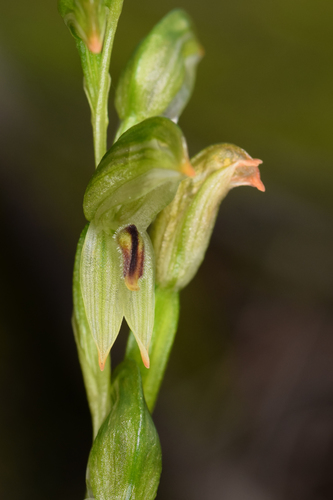
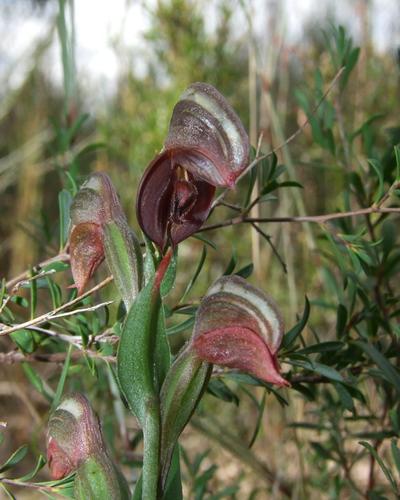
Pterostylis sanguinea D.L.Jones & M.A.Clem. is a terrestrial, perennial, deciduous herb that grows from an underground tuber. Non-flowering individuals produce a rosette of three to ten linear to lance-shaped leaves. Each leaf is 20–40 mm (0.8–2 in) long and 6–15 mm (0.2–0.6 in) wide, and the rosette sits on a stem 20–40 mm (0.8–2 in) long. When flowering, this species produces twelve or more dark reddish-brown, green, or green and brown flowers arranged on a flowering spike that reaches 150–400 mm (6–20 in) in height. The flowering spike bears between six and ten stem leaves, which measure 20–50 mm (0.8–2 in) long and 6–12 mm (0.2–0.5 in) wide. Individual flowers are 15–25 mm (0.6–1 in) long and 12–20 mm (0.5–0.8 in) wide. The dorsal sepal and petals join to form a hood that covers the column. The lateral sepals turn downwards, measure 11–14 mm (0.4–0.6 in) long and 12–14 mm (0.5–0.6 in) wide, and are joined for most of their length. The labellum is dark brown, hairy, and shaped like an insect; it is about 6 mm (0.2 in) long and 4 mm (0.2 in) wide, and flicks upwards when touched. Flowering takes place from June to September. Pterostylis sanguinea is distributed from north of Kalbarri north to Toolinna Cove in Western Australia, in the southeast of South Australia, and in disjunct areas of Victoria west of Yarram. In Tasmania, it is only found in Strzelecki National Park on Flinders Island. It grows in forest and woodland in well-drained soils.