About Pterostylis melagramma D.L.Jones
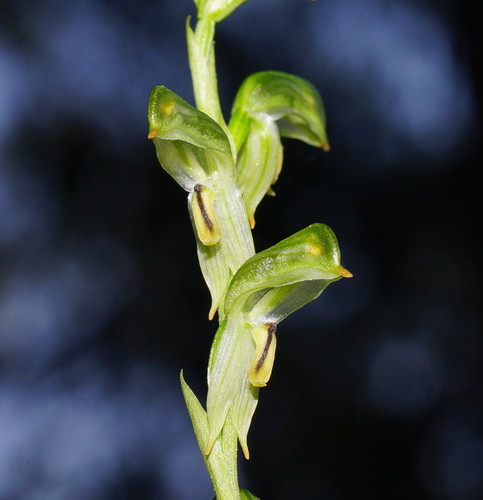
Pterostylis melagramma D.L.Jones, commonly known as the black-stripe leafy greenhood, is a terrestrial, perennial, deciduous herb that grows from an underground tuber. Non-flowering individuals produce a rosette of three to six narrow egg-shaped leaves; each leaf is 13–50 mm (0.5–2 in) long and 4–11 mm (0.2–0.4 in) wide, borne on a stalk 30–100 mm (1–4 in) high. Flowering plants bear up to twenty translucent flowers marked with faint darker lines, arranged on a flowering spike that grows 150–800 mm (6–30 in) tall. The flowering spike has between five and seven stem leaves, each measuring 25–80 mm (1–3 in) long and 5–10 mm (0.2–0.4 in) wide. Individual flowers are 13–15 mm (0.5–0.6 in) long and 4–8 mm (0.2–0.3 in) wide. The dorsal sepal and petals are fused to form a hood that covers the column, and the dorsal sepal curves sharply downwards near its often brown-tipped end. The lateral sepals are turned downwards, are 11–13 mm (0.4–0.5 in) long and 6–7 mm (0.2–0.3 in) wide, and are joined to each other for about half their length. The labellum is about 5 mm (0.2 in) long and 2 mm (0.08 in) wide, brownish-yellow and hairy, with a dark stripe running along its mid-line. Flowering takes place from June to November. This species is widely distributed and common in higher rainfall areas of Victoria and Tasmania, and also grows in south-eastern South Australia and southern New South Wales.