About Pterostylis graminea Hook.f.
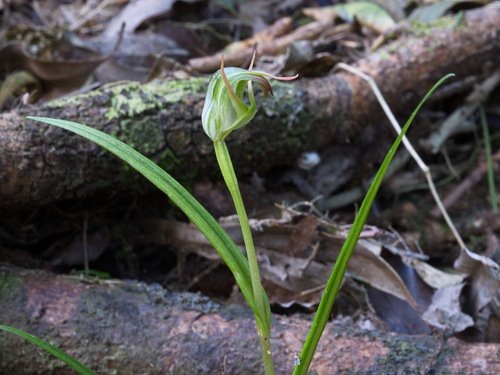
Pterostylis graminea Hook.f. is a terrestrial, perennial, deciduous herb that grows from an underground tuber. It produces between four and six erect, grass-like leaves that range from linear to lance-shaped, are V-shaped in cross-section, and measure 80–150 mm (3–6 in) long and 5–10 mm (0.2–0.4 in) wide. The uppermost leaves are the longest, and grow taller than the plant's flower. A single yellowish green flower with transparent white stripes is borne on a flowering stem that reaches up to 330 mm (13 in) high. The dorsal sepal and petals are fused together to form a hood, also called a 'galea', that covers the column. The dorsal sepal stays roughly upright near its base, then suddenly curves forward to point below horizontal. The petals are slightly flared, and are slightly shorter than the dorsal sepal. There is a wide gap between the lateral sepals and the galea. The lateral sepals have thread-like tips that are held erect, spread slightly apart from each other, and grow taller than the galea. The labellum is greenish-brown, darker toward its tip, curved, and protrudes above the sinus. Flowering takes place between September and January. This species, commonly called the grass-leaved greenhood, grows in forest and scrub, and sometimes occurs on wetland margins. It can be found on the North Island, South Island, and Stewart Island, at altitudes up to 1,000 m (3,300 ft).